

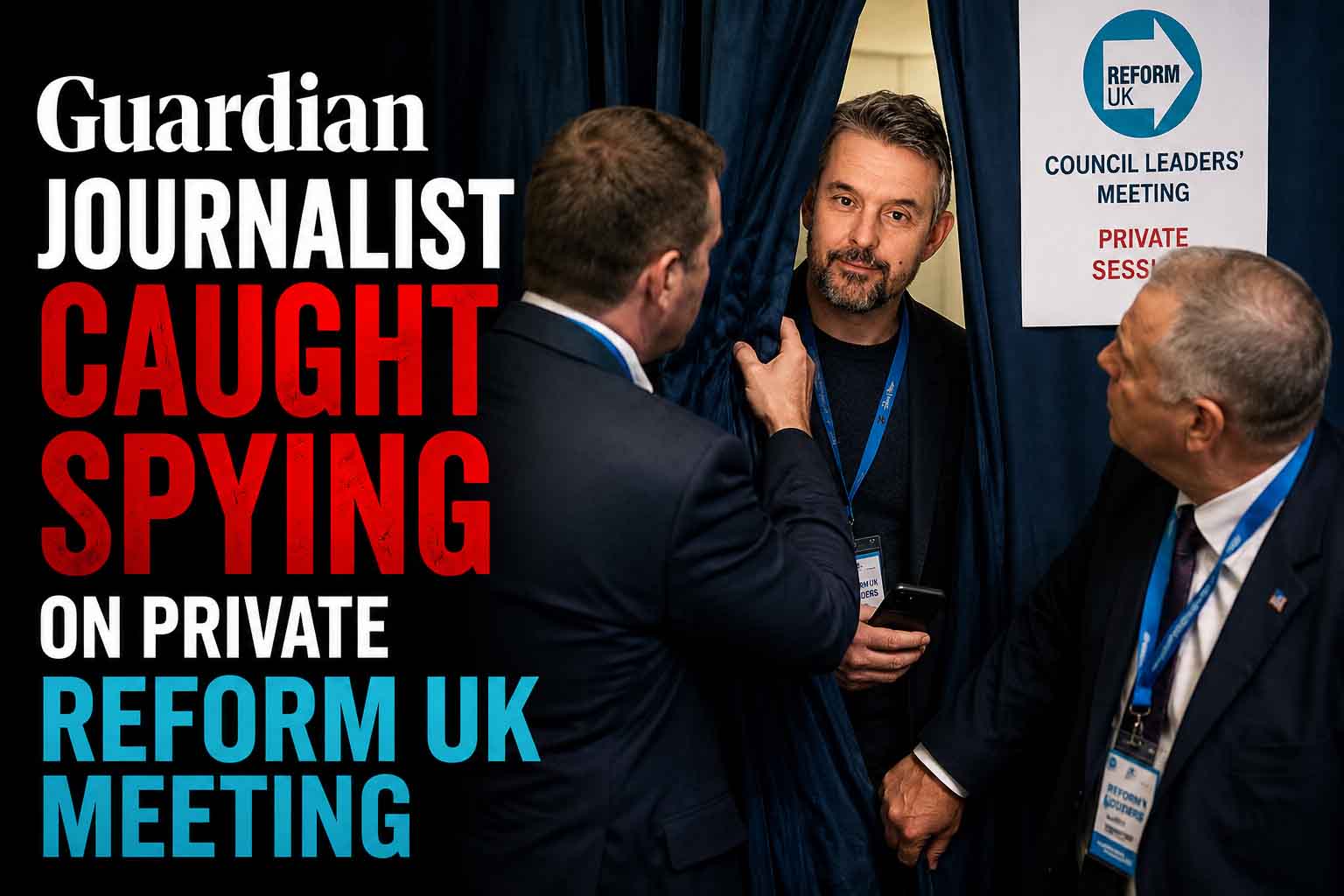
Guardian journalist caught spying on private Reform UK meeting
Trust in the mainstream media has been declining for years, and incidents such as the controversy surrounding The Guardian at this year’s Local Government Association (LGA) Conference are unlikely to restore public confidence.
Reform UK has accused Guardian political journalist Peter Walker of entering a private meeting of its council leaders, remaining inside after the session had been closed, and attempting to observe or record confidential discussions. Video footage circulated on social media appears to show Walker being challenged and escorted from the room, while Reform figures, including Deputy Leader Richard Tice, have publicly condemned his conduct.
If Reform UK’s account is accurate, it represents a serious lapse in journalistic judgement.
Political journalism plays a vital role in holding those in power to account. Investigative reporting has exposed corruption, wrongdoing and abuses of authority that might otherwise have remained hidden. But those responsibilities also carry clear ethical boundaries.
There is a significant difference between questioning politicians in public, investigating matters that are genuinely in the public interest, and remaining inside a meeting that organisers intended to be private. If a meeting is clearly designated as closed, journalists should respect those boundaries unless there is compelling evidence that remaining inside is necessary to expose serious wrongdoing.
At present, there is no independent public evidence confirming Reform UK’s allegations that Walker was secretly recording the meeting or that he deliberately misled officials when challenged. Those claims remain allegations, and it is important that they are treated as such until corroborated.
Nevertheless, the optics of the incident are damaging.
For years, many media organisations have criticised politicians who attempt to evade scrutiny or operate behind closed doors. They have rightly championed transparency, accountability and professional standards. Those same principles should apply equally to journalists themselves.
Whether the incident ultimately proves to have been a misunderstanding or something more serious, it reinforces an uncomfortable reality for the news industry: public trust is fragile. When journalists appear to blur ethical boundaries, even inadvertently, they risk undermining confidence not only in themselves but in the profession as a whole.
The episode has also become politically significant because it involves Reform UK, a party that has frequently argued it receives unfair treatment from parts of the national media. Supporters see the incident as evidence of institutional bias, while critics caution against drawing sweeping conclusions before all the facts are established.
Whatever one’s political views, the central issue should not be whether the meeting involved Reform UK, Labour, the Conservatives or any other party. The same standards should apply across the board.
Journalists should be free to investigate robustly, but they should also be prepared to explain their methods and be held accountable when legitimate questions arise about their conduct. Likewise, politicians should expect scrutiny, but they should also be entitled to hold genuinely private meetings where appropriate.
As more information emerges, the public will be able to judge exactly what happened. Until then, speculation should not replace evidence. What is already clear, however, is that the controversy has sparked an important debate about where the line should be drawn between determined reporting and respect for ethical boundaries.