

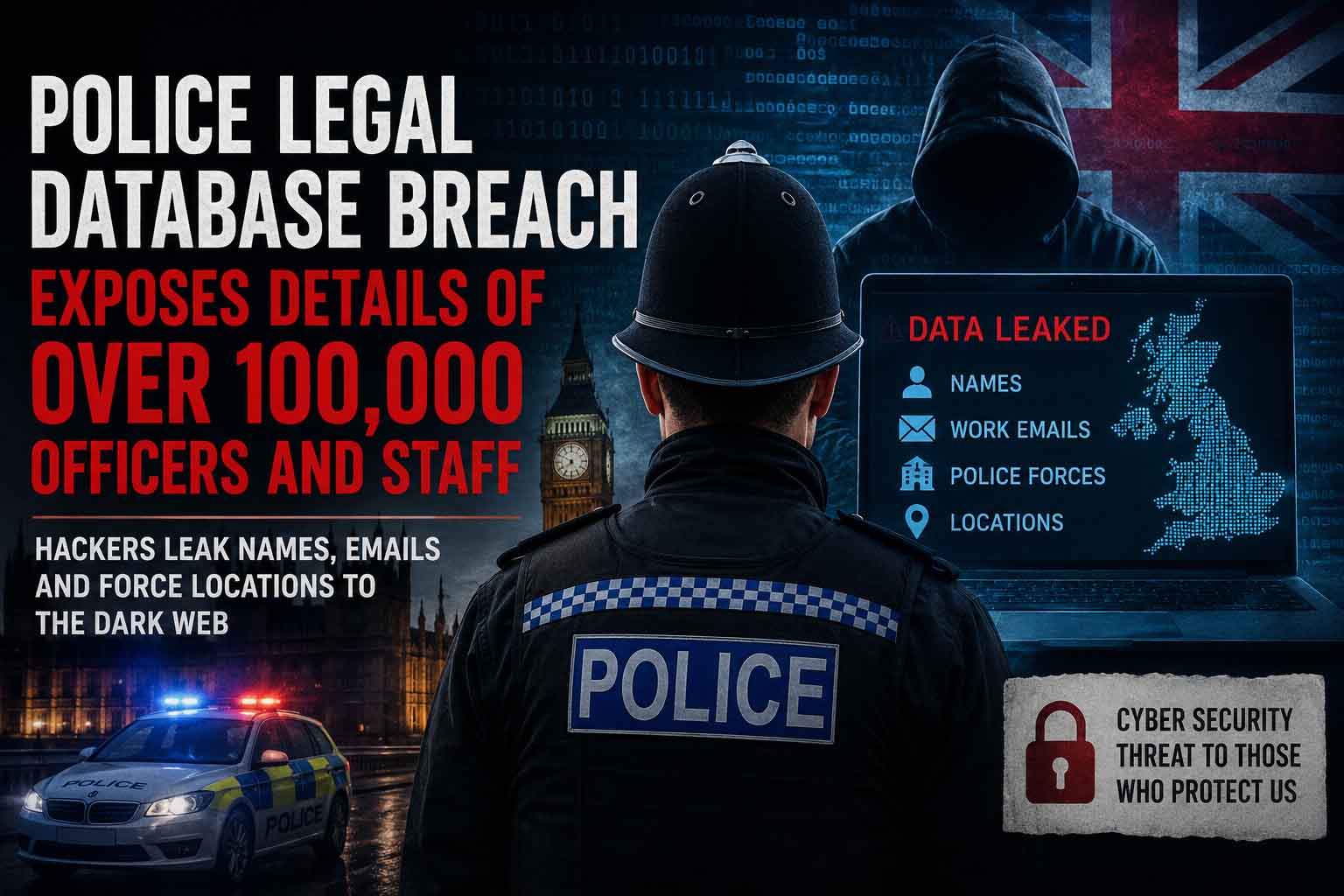
Police Legal Database Breach Exposes Details of More Than 100,000 Officers and Staff
A major cyberattack on the Police National Legal Database (PNLD) has resulted in the personal details of more than 100,000 police officers, civilian staff and criminal justice professionals being published on the dark web, raising fresh concerns about the resilience of the UK’s public sector cyber defences.
The breach, which was confirmed by the PNLD and reported by several national newspapers, is understood to have been carried out by the hacking group known as ExfilSquad. The incident follows a series of recent attacks against UK public sector organisations and has prompted renewed debate about the security of government-held data.
What Is the Police National Legal Database?
The Police National Legal Database is an online legal reference system used by police forces and criminal justice agencies across the United Kingdom. Rather than storing criminal records or intelligence, it provides officers and legal professionals with access to legislation, case law and operational legal guidance.
Although the system does not contain frontline policing intelligence, it maintains subscriber records for those authorised to use the service.
What Information Was Leaked?
According to reports, approximately 114,000 subscriber records were compromised.
The leaked data is understood to include:
- Names
- Official work email addresses
- Police force or employing organisation
- Professional contact information
At the time of writing, there is no evidence that operational police databases, criminal records or intelligence systems were accessed. The breach appears to be confined to the database containing user account information for authorised subscribers.
Multiple Agencies Affected
The leaked records reportedly extend beyond police forces and include personnel from several government and criminal justice organisations.
These include:
- Crown Prosecution Service
- Home Office
- National Crime Agency
- Ministry of Defence
While much of the information consists of professional contact details, cybersecurity experts warn that such data can still be highly valuable to criminals.
Why the Breach Matters
For most organisations, the exposure of employee names and work email addresses would primarily present a cybersecurity concern. For police officers and criminal justice personnel, however, the consequences may be considerably more serious.
Information linking individuals to specific police forces or agencies can potentially be used to:
- Conduct highly targeted phishing attacks.
- Impersonate police personnel.
- Support social engineering campaigns.
- Identify officers working within particular regions or specialist units.
- Assist organised criminal groups in gathering intelligence on law enforcement personnel.
Although there is no suggestion that officers’ home addresses or financial information have been released, security specialists frequently warn that seemingly routine professional information can form the foundation of more sophisticated cyberattacks.
Part of a Wider Pattern
The attack is not an isolated incident.
ExfilSquad has also claimed responsibility for the recent cyberattack on the Department for Education, where hundreds of thousands of records relating to education professionals and government staff were reportedly compromised.
Taken together, the attacks suggest that UK public sector organisations remain attractive targets for organised cybercriminals seeking to obtain sensitive government data.
The National Cyber Security Centre, the National Crime Agency and the Information Commissioner’s Office are understood to be involved in responding to the latest incidents.
Digital ID Debate Reignited
The breach has also reignited discussion surrounding proposals for future digital identity systems in the United Kingdom.
Commentators on social media have argued that if government organisations continue to suffer significant data breaches, public confidence in any future centralised digital identity infrastructure could be undermined.
It is important to note, however, that the PNLD incident does not involve any Digital ID programme, nor does it demonstrate that such systems would necessarily be vulnerable to similar attacks.
Nevertheless, cybersecurity experts have long warned that as governments collect and centralise larger volumes of personal information, the potential impact of any successful breach inevitably increases. Any future Digital ID framework would therefore require exceptionally robust cybersecurity protections, strict governance and continuous independent oversight.
A Continuing Challenge
Cyberattacks against government bodies have become increasingly frequent in recent years, reflecting the growing sophistication of criminal hacking groups and the value of public sector data.
While the information exposed in this incident may not include operational policing intelligence, it highlights the importance of protecting even seemingly routine administrative records. For police officers, prosecutors and government officials, professional contact information can itself become a valuable asset for hostile actors.
As investigations continue, the incident serves as another reminder that cybersecurity is no longer simply an IT issue. It has become a matter of national resilience, public confidence and, in some cases, personal safety.