

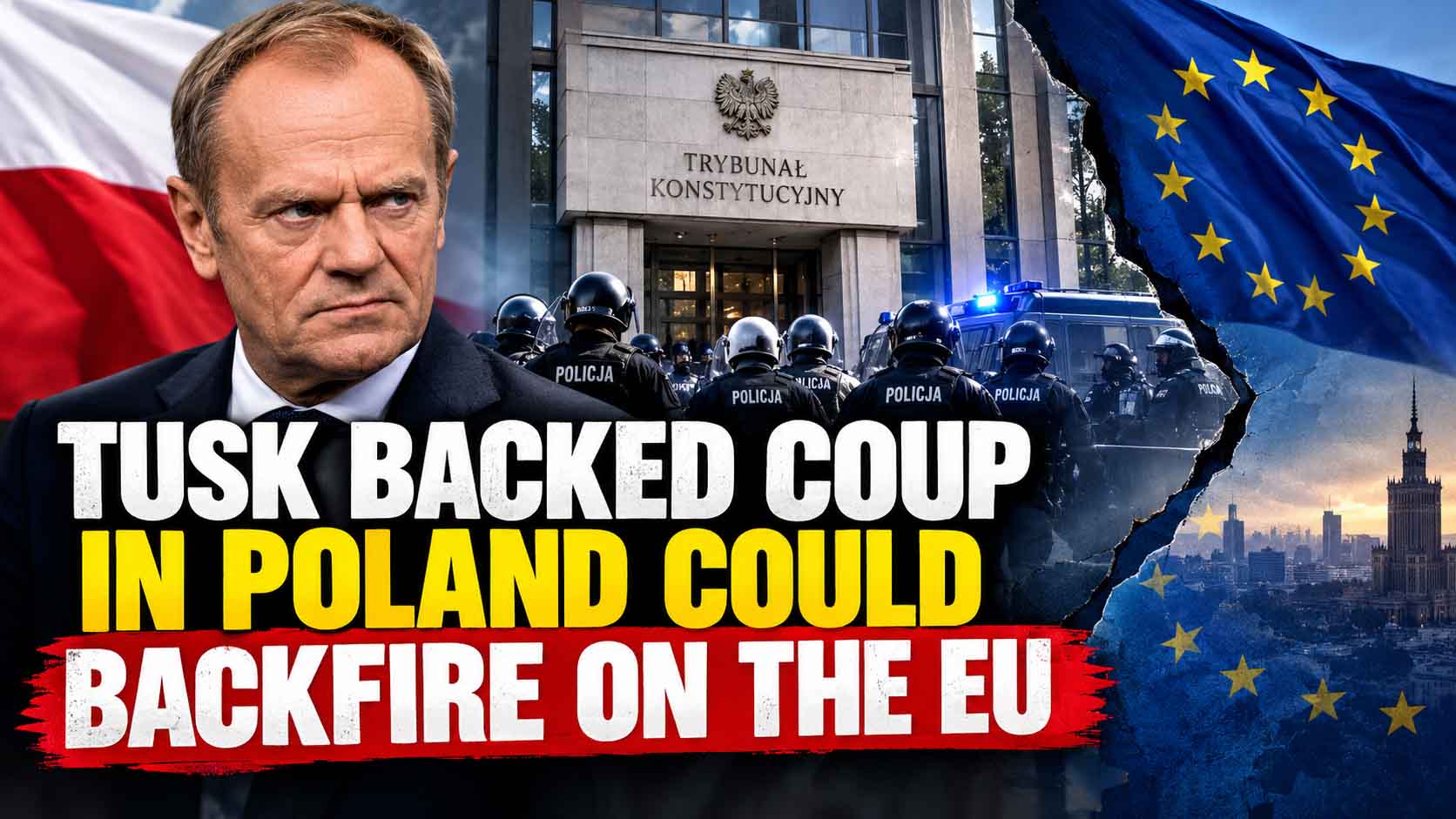
Tusk backed coup in Poland could backfire on the EU
The dramatic escalation of the conflict surrounding Poland’s Constitutional Tribunal has brought the country to the brink of a profound institutional crisis. With riot police deployed outside the court’s Warsaw headquarters and conflicting claims of judicial legitimacy paralyzing the state’s highest legal body, Prime Minister Donald Tusk’s government faces accusations of executing a constitutional coup. While the current administration frames the intervention as a painful but necessary step to restore the rule of law, the aggressive maneuvers risk precipitating a massive domestic backlash that could ultimately damage the European Union’s long-term interests in the region.
For years, the European establishment has viewed the judicial reforms enacted by the previous Law and Justice (PiS) administration as a systemic threat to democratic norms, culminating in rulings by the European Court of Justice that questioned the independence of the Tribunal. However, the methods now deployed by the pro-EU coalition to dismantle that legacy have drawn sharp criticism, even from legal experts traditionally aligned against PiS. The suspension of Tribunal President Bogdan Święczkowski by a lower-tier appointment and the subsequent deployment of security forces have been widely condemned by opponents as an extra-legal seizure of power.
Critics argue that the European Union’s conspicuous silence during these extraordinary events signals a tacit endorsement of the government’s heavy-handed tactics. To a significant portion of the Polish electorate, this perceived double standard suggests that Brussels values political alignment over genuine adherence to constitutional processes. By appearing to tolerate executive overreach when carried out by a Europhile administration, the EU risks validating claims that its prior defense of the rule of law was merely a partisan tool used to discipline a sovereign, conservative government.
This dynamic threatens to achieve the exact opposite of Donald Tusk’s stated goals. Rather than stabilizing the judiciary and integrating Poland more deeply into the European mainstream, an overreliance on coercive state power to enforce judicial compliance could catalyze a powerful domestic counter-reaction. If ordinary citizens conclude that the current administration represents a capitulation to external European pressure at the expense of national sovereignty, public sentiment may shift decisively.
Far from pacifying the opposition, the image of armed police cordoning off the highest court in the land provides a potent rallying cry for nationalist forces. By overplaying its hand in the pursuit of a rapid institutional purge, the Tusk government may inadvertently unite a fractured public against Brussels, fostering a renewed wave of Euroscepticism that could paralyse Polish politics and destabilise the EU’s eastern flank for a generation.