
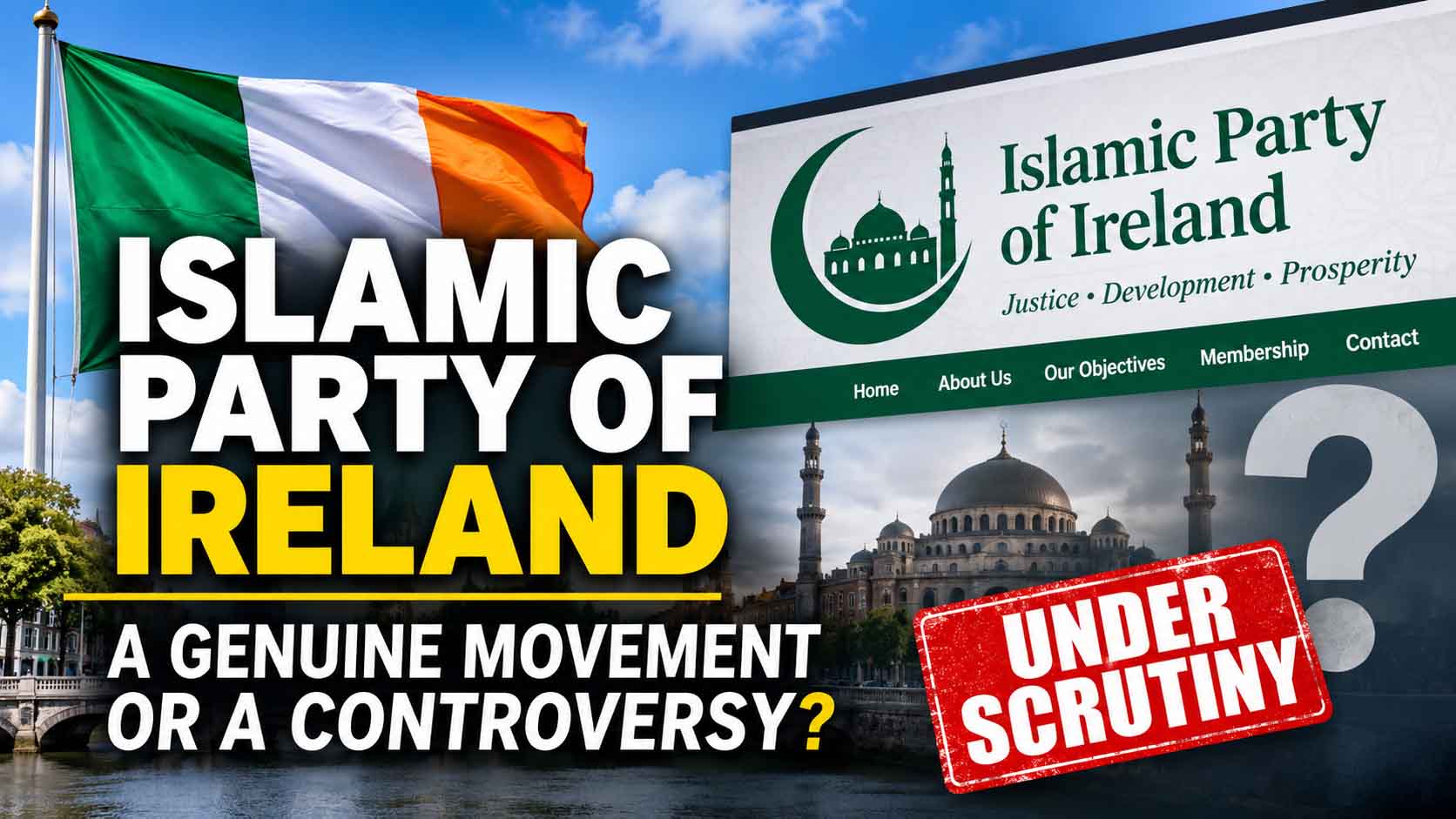
Islamic Party of Ireland
Who Is Behind the Controversial Political Movement?
An organisation presenting itself as an Islamic political party in Ireland has attracted growing attention following the publication of its constitution, claims of an Islamic shadow government and questions about its origins. But is it a genuine political movement, and what does it intend to achieve?
A website claiming to represent an Islamic political movement in Ireland has raised a number of important questions about religious identity, democratic representation and the relationship between religious law and the Irish Constitution.
The organisation, operating through the website IslamicParty.ie, uses several names, including the Islamic Party of Ireland and the Islamic Labour Party of Ireland. Its published constitution outlines an organisation with an explicitly Islamic foundation, including religious requirements for membership and leadership.
While the organisation appears to be positioning itself as a political voice for Muslims in Ireland, its emergence has been met with scepticism, including an explicit rejection from the Irish Muslim Council. An investigation by TheJournal.ie has also raised questions about its origins and the individuals potentially connected to the website.
There is, as yet, little evidence of a substantial political organisation behind the claims.
An explicitly Islamic political organisation
The organisation’s website presents an ambition to influence Irish society and politics through an Islamic framework. Its stated objectives include representing Muslim interests, promoting social and economic justice, and reforming aspects of Irish society in accordance with Islamic principles.
However, it is the organisation’s constitution that provides some of the most revealing details about its proposed structure.
Membership is restricted to adult Muslims, with applicants required to obtain a recommendation from a mosque or Islamic centre.
The leadership requirements are even more specific. According to the published constitution, the party leader must be a Muslim man, hold Irish citizenship, have recognised achievements in Islamic work and possess extensive knowledge of Sharia, or Islamic jurisprudence.
These provisions go beyond the conventional approach of a political party whose members happen to share religious beliefs. They establish religious identity, gender and religious credentials as formal conditions for participation and leadership.
That raises legitimate questions about the organisation’s understanding of political representation and how it intends to reconcile its internal rules with Ireland’s constitutional commitment to equality and democratic participation.
Claims of an Islamic shadow government
Perhaps the most striking feature of the organisation’s published material is its claim to have established a shadow government.
According to its website, this body was established on 16 October 2026 and is intended to develop plans and strategies for governing Ireland.
The terminology is significant. A shadow government normally refers to an organised political alternative to an existing government, usually comprising elected representatives or an established opposition party.
In this instance, however, there is no publicly verified evidence of an elected mandate, parliamentary representation or the organisational infrastructure normally associated with such a body.
There is also no independently established information about its membership, the individuals appointed to its various positions or the process through which they were selected.
Consequently, the organisation’s claim should be treated with caution. Publishing details of a purported shadow government does not establish that it represents a credible political alternative or has any democratic mandate.
Is it a registered political party?
Despite its political ambitions, the organisation is not registered as a political party in Ireland.
The Irish Electoral Commission has reportedly confirmed that it has no registration for the organisation and is not in correspondence with it.
This distinction is important. An organisation can campaign, promote political ideas and organise supporters without being formally registered as a political party. However, registration is required to contest elections under a party name and have its emblem appear on ballot papers.
For an organisation seeking formal registration, Irish electoral rules also impose membership and organisational requirements, including a minimum of 300 members aged 18 or over, at least half of whom must be registered to vote, alongside the necessary constitutional documentation.
At present, therefore, the Islamic Party of Ireland has no recognised status as a registered political party.
Its claims of political representation should be considered in that context.
Who is behind the organisation?
Perhaps the biggest unanswered question concerns the people responsible for establishing and operating the website.
An investigation published by The Journal.ie on 15 November 2026 examined the website’s technical information and identified several potentially interesting connections.
The investigation found that the domain was registered on 2 October 2025. It also identified a WordPress author profile using the name “user 5”, which appeared to be connected to an individual named Muhammad Hafez on another website.
Hafez is identified as chairman of the Irish Islamic Chamber of Commerce and is also associated with AWQAF Ireland, an organisation concerned with Islamic religious endowments.
The investigation identified technical similarities between IslamicParty.ie and AWQAF Ireland’s website, including the use of the same WordPress theme.
These findings raise questions about possible connections between the websites and the people involved in their operation.
However, it is important not to draw conclusions beyond the available evidence. A technical connection or an author profile does not establish who founded the political organisation, who controls it or whether the individuals identified have any formal involvement in its political activities.
The investigation did not conclusively establish the identity of the organisation’s founders or leadership.
It also reported that attempts to obtain clarification had not received a response by the time of publication.
Ireland’s Muslim community distances itself
One of the most significant developments has been the response from the Irish Muslim Council (IMC).
On 14 November 2026, the council issued a public statement explicitly distancing itself from the organisation.
It said it had no connection whatsoever with the alleged political party and rejected the concept of establishing an Islamic political party based exclusively on religious identity.
The council also expressed concern that the claims surrounding the organisation could be misleading and potentially contribute to Islamophobia.
Its statement is important because the website appears to present itself as representing the interests of Ireland’s Muslim population. Yet a prominent Muslim representative organisation has made clear that it does not endorse or support the initiative.
It would therefore be misleading to suggest that the organisation speaks for Irish Muslims generally.
Ireland’s Muslim population, like any religious community, comprises individuals with a wide range of political opinions, social attitudes and approaches to public life.
The activities of one organisation should not be attributed to an entire religious community.
A genuine political movement or an elaborate provocation?
There are two broad possibilities surrounding the organisation’s emergence.
The first is that it represents a genuine, albeit relatively undeveloped, attempt to establish an Islamic political movement in Ireland.
The publication of a constitution, the maintenance of a dedicated website, the existence of related video content and the claims surrounding its shadow government suggest that at least some effort has gone into presenting it as an organised political entity.
It is possible that its organisers intend to develop a political movement, attract members and eventually seek formal recognition.
The alternative is that the website is primarily intended to provoke controversy or generate publicity.
There are several unusual features that warrant further investigation. These include the absence of publicly identified leadership, the lack of independently verified membership figures, incomplete sections of the website and technical references that appear unusual for an established Irish political organisation.
The investigation by TheJournal.ie has also raised questions about the website’s origins and potential connections.
The possibility of a deliberate provocation cannot be ruled out, but neither has it been established.
Until the individuals behind the project come forward and provide verifiable information about their objectives, funding, membership and organisational structure, its true purpose remains uncertain.
The wider question: religion and democratic government
Regardless of whether the organisation ultimately develops into a functioning political party, its published constitution raises broader questions about the role of religion in democratic politics.
In a democratic society, people are entitled to organise politically around their religious beliefs. Religious values can legitimately influence political opinions, public policy and individual voting decisions.
There is nothing inherently undemocratic about a political party whose policies are informed by Christianity, Islam, Judaism or another belief system.
However, there is an important distinction between a party that draws inspiration from religious values and one that formally restricts membership and leadership according to religious identity and gender.
The latter raises questions about equality, representation and the rights of people who do not share the organisation’s religious beliefs.
There are also important questions about the relationship between Sharia and the Irish legal system.
Would the organisation accept the supremacy of Irish law? How would it approach religious freedom, freedom of expression and the rights of people outside Islam? What would its position be on the legal equality of men and women?
These are reasonable questions for any political organisation seeking to influence the governance of a modern European democracy.
They should be answered through examination of its actual policies and statements, rather than assumptions about what its religious identity might imply.
Questions that remain unanswered
For an organisation claiming to have political ambitions for Ireland, a considerable amount of basic information remains unavailable.
Among the questions that deserve clear answers are:
- Who founded the organisation, and who currently controls it?
- Who finances its activities?
- How many members does it actually have?
- Who appointed its purported shadow government?
- What does it mean in practical terms by reforming Ireland according to Sharia?
- Does it accept the supremacy of the Irish Constitution and the country’s existing legal system?
- What are its positions on religious freedom, gender equality and the rights of non-Muslims?
- Does it intend to seek formal registration and contest elections?
Until these questions are answered, it is difficult to assess whether the organisation represents a serious political initiative or something considerably less substantial.
Conclusion: scrutiny is essential, but so are facts
The emergence of IslamicParty.ie raises legitimate questions about religious political movements, democratic accountability and the relationship between religious law and the institutions of a modern European state.
The organisation’s constitution is particularly noteworthy because it establishes religious and gender-based requirements for membership and leadership. Its claims to have established a shadow government also deserve scrutiny, particularly in the absence of any demonstrated electoral mandate or recognised political structure.
However, there is an equally important need to distinguish between the actions of this particular organisation and the wider Muslim population in Ireland.
The Irish Muslim Council has already made clear that it does not support or represent the initiative.
Ultimately, the public deserves transparency. Any organisation seeking to influence the political future of Ireland should be prepared to explain who it represents, how it is funded, what it intends to achieve and how its proposed policies would operate within the country’s democratic and constitutional framework.
Those questions are not Islamophobic. They are fundamental questions of democratic accountability, and they should be asked of every political organisation, regardless of its religious or ideological foundations.