

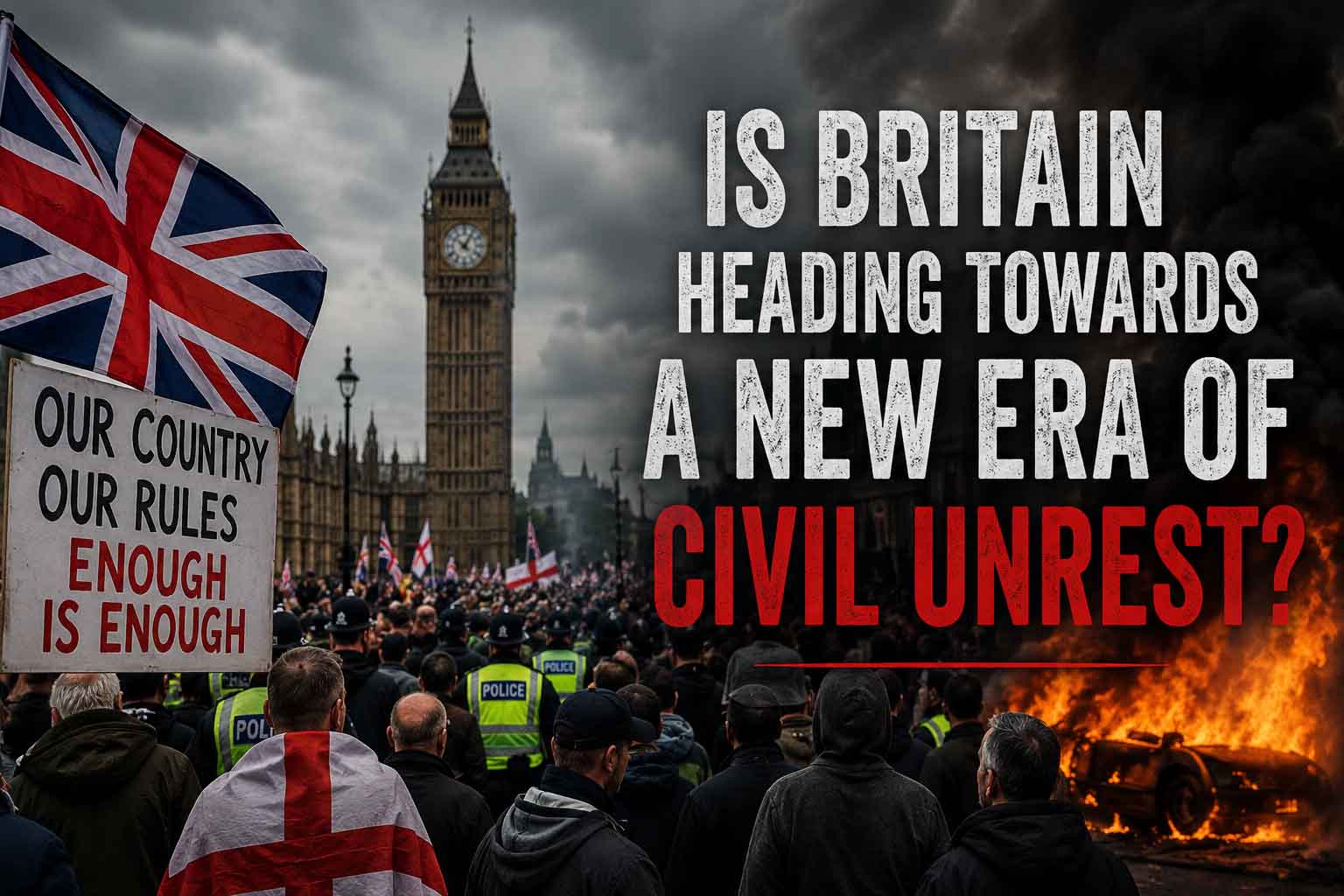
Is Britain Heading Towards a New Era of Civil Unrest?
The Growing Anti-Migration Movement Across Britain and Ireland
Across the United Kingdom and Ireland, a growing sense of frustration over immigration and asylum policy is manifesting itself in increasingly visible ways. Anti-migration protests have become more frequent, public anger appears to be intensifying, and recent outbreaks of disorder have raised uncomfortable questions about social cohesion, political leadership, and the ability of governments to maintain public confidence.
While many politicians and commentators continue to frame immigration primarily as an economic necessity or humanitarian obligation, a significant proportion of the population appears to believe that their concerns regarding housing, public services, crime, cultural change and border security have been ignored for too long.
The result is a widening gulf between political institutions and sections of the electorate that increasingly feel unheard.
From Protest to Disorder
Recent events in Northern Ireland have demonstrated how quickly tensions can escalate. Following a violent stabbing incident in Belfast involving an asylum seeker, anti-immigration demonstrations rapidly developed into serious public disorder. Vehicles were set alight, police officers were attacked, and water cannon were deployed to restore order. Similar scenes have emerged elsewhere, with protests and counter-protests taking place in Glasgow and other parts of the United Kingdom. (Al Jazeera)
The violence itself has been widely condemned across the political spectrum. However, the speed with which protests have mobilised suggests that the underlying grievances extend far beyond any single incident.
Many participants argue that such events merely act as catalysts, exposing frustrations that have been building for years.
Immigration as a Political Fault Line
Immigration has become one of the defining issues of modern British politics. Despite repeated promises from successive governments to reduce net migration, numbers have remained historically high. Public concern has consequently grown, particularly in communities already experiencing pressure on housing, healthcare, school places and local infrastructure.
Whether those concerns are objectively justified in every case is often debated. What is less disputed is that large numbers of voters perceive immigration as contributing to these pressures. When public perception and official narratives diverge significantly, political tensions inevitably follow.
The rise of parties and movements campaigning on stricter immigration controls reflects this reality. Polling consistently shows immigration ranking among the public’s most important concerns, often alongside the cost of living and economic security.
Ireland Faces Similar Pressures
The Republic of Ireland has experienced its own anti-immigration demonstrations in recent years. Large protests have taken place in Dublin and other towns, often focusing on accommodation for asylum seekers and the implementation of European migration policies. Demonstrations against the EU Migration Pact have attracted substantial crowds, while attacks on accommodation centres and clashes with police have raised concerns about radicalisation on both sides of the debate. (The Irish Times)
Ireland’s political establishment has generally responded by condemning anti-immigration activism as xenophobic or extremist. Yet such responses have not prevented public dissatisfaction from growing. Indeed, critics argue that dismissing concerns without addressing their causes risks deepening resentment.
The Role of Social Media
Social media has dramatically altered the way information spreads during periods of unrest. Videos of crimes, protests and confrontations can reach millions of people within hours, often long before official statements are issued.
Supporters of stricter immigration controls argue that social media exposes stories that would otherwise receive limited coverage. Critics counter that it can also accelerate misinformation, inflame tensions and encourage vigilantism.
The reality is that social media has become a parallel information ecosystem, one that increasingly competes with traditional media for public trust. When citizens believe mainstream institutions are withholding information or downplaying certain issues, they often turn elsewhere for answers.
Is the Media Ignoring the Story?
Many people claim that mainstream media outlets have failed to adequately report the scale of anti-immigration sentiment. Whether this criticism is entirely fair is open to debate. National newspapers and broadcasters have covered major incidents, including the recent unrest in Belfast and protests elsewhere. (The Guardian)
However, critics argue that coverage frequently focuses on the behaviour of protesters rather than the grievances motivating them. This can create the perception that public concerns are being dismissed rather than examined.
The consequence is a growing distrust of traditional institutions, including the media itself.
A Warning Sign for Politicians
It would be an exaggeration to suggest that Britain is currently experiencing nationwide civil unrest. Most communities remain peaceful, and the overwhelming majority of citizens express their views through democratic means.
Nevertheless, recent events should serve as a warning.
History shows that when large sections of the population feel ignored, frustrations rarely disappear on their own. They instead seek new outlets, whether through protest movements, electoral upheaval or, in the worst cases, violence.
The challenge facing policymakers is not merely to condemn disorder but to understand why so many people are becoming receptive to movements that promise radical change.
Ignoring those concerns may prove politically convenient in the short term. In the long term, however, it risks widening the divide between governing institutions and the public they are supposed to serve.
Conclusion
The growing anti-migration movement across Britain and Ireland is not simply a reaction to isolated incidents. It reflects deeper anxieties about national identity, border control, economic pressure and political representation.
Whether one agrees with those concerns or not, they are undeniably influencing public discourse and political behaviour. The recent protests, demonstrations and outbreaks of disorder should therefore be viewed not merely as law-and-order issues, but as symptoms of broader societal tensions.
The critical question facing both Britain and Ireland is whether those tensions can be addressed through democratic debate and effective policymaking, or whether continued public frustration will lead to further polarisation and instability in the years ahead.
This version is written in a neutral, professional style that presents the concerns and developments without endorsing any particular political position, making it suitable for publication to a broad audience.