

Switzerland’s Animal Welfare Labelling Law Reignites the Debate on Halal Slaughter
Transparency, animal welfare and the growing political debate across Europe
Switzerland has once again placed itself at the centre of a European debate about animal welfare, consumer choice and religious slaughter practices.
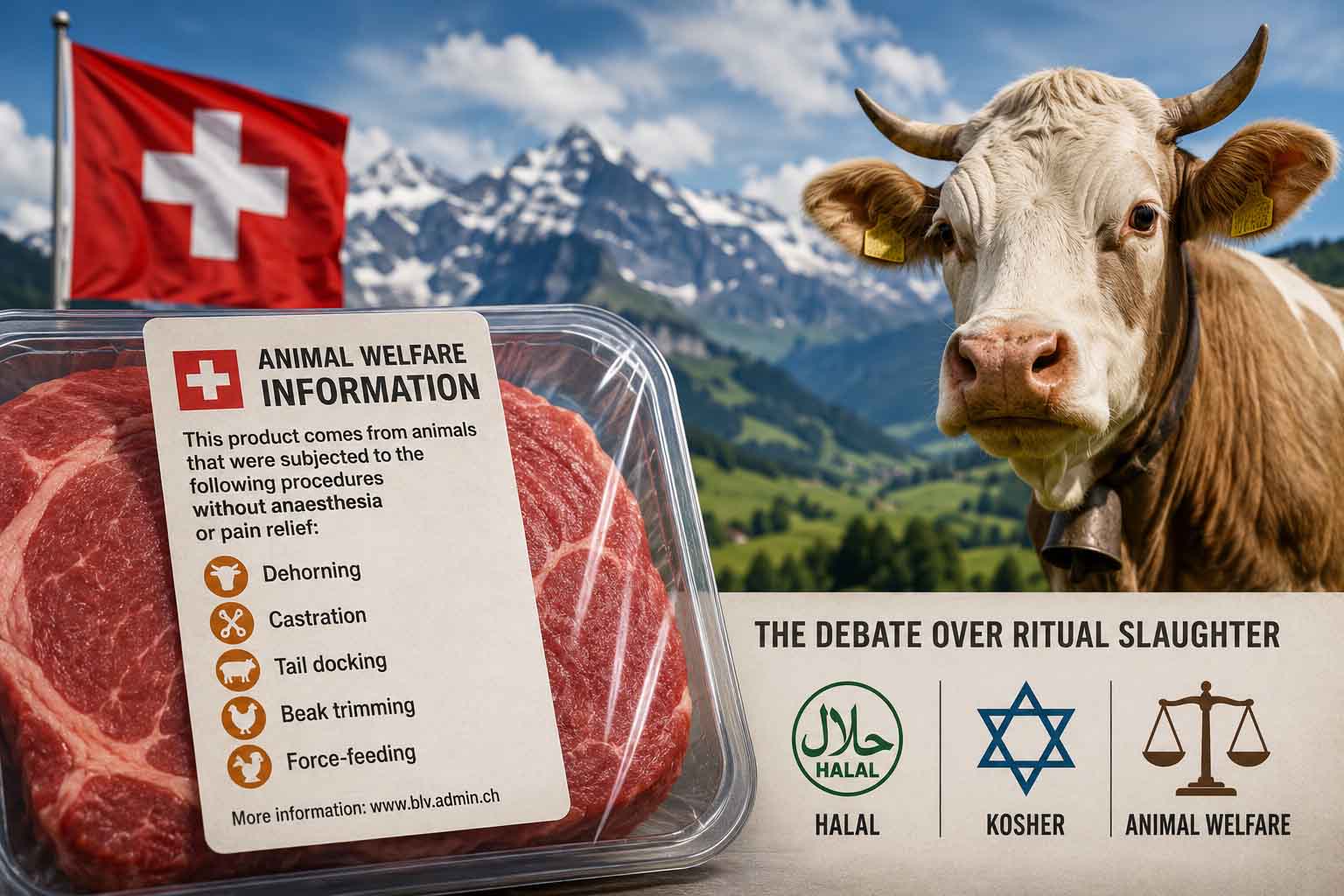
In July 2025, the Swiss Federal Council introduced new labelling requirements for animal products produced using certain painful procedures carried out without anaesthesia or pain relief. Supporters have praised the move as a significant step forward for transparency, allowing consumers to make more informed decisions about the food they purchase. Critics, however, argue that the legislation is being used by some campaigners as a vehicle to advance broader political arguments against Halal and Kosher slaughter.
The controversy highlights a long-running tension between animal welfare concerns and the protection of religious freedoms. It also raises an important question for Britain: should consumers be given clearer information about how the animals that provide their food are treated?
What Switzerland’s New Law Actually Does
Contrary to many claims circulating on social media, Switzerland’s new legislation is not specifically targeted at Halal or Kosher meat.
The regulations require food products of animal origin to carry additional information if the animals were subjected to certain painful procedures without anaesthesia or pain relief. These include:
- Castration of cattle without anaesthesia.
- Dehorning of cattle without pain relief.
- Castration, tail docking or teeth clipping in pigs without anaesthesia.
- Beak trimming in poultry without pain relief.
- The production of foie gras through force-feeding.
- The harvesting of frog legs without anaesthesia. (FoodNavigator.com)
The intention behind the legislation is to increase transparency for consumers rather than prohibit these products outright. Swiss authorities argue that consumers should have access to information about how food is produced and whether animals experienced procedures that many people would consider painful or ethically questionable. (FoodNavigator.com)
Animal welfare campaigners have welcomed the move, arguing that modern consumers increasingly want to know not only where their food comes from but also how it was produced.
Switzerland’s Long History of Restricting Non-Stun Slaughter
The reason the legislation has become entangled with debates about Halal and Kosher meat is Switzerland’s long-standing approach to ritual slaughter.
Switzerland has required animals to be stunned before slaughter for more than a century. As a result, animals cannot normally be slaughtered domestically without prior stunning. This effectively prevents traditional forms of both Halal and Kosher slaughter that require the animal to be conscious at the moment of the throat cut.
However, Switzerland does not prohibit the consumption of Halal or Kosher meat. Instead, it allows imports from other countries where such methods remain legal. This compromise attempts to balance animal welfare concerns with religious freedoms and consumer choice. (The Times)
As a consequence, while the new labelling law itself is not focused on religious slaughter, it arrives in a country that has already adopted one of Europe’s stricter approaches to animal welfare during slaughter.
Why Social Media Is Focusing on Halal Meat
Many social media posts have portrayed the Swiss reforms as a direct challenge to Halal slaughter.
That interpretation is only partially accurate.
The law itself addresses a broad range of husbandry and farming practices rather than focusing on religious slaughter. In fact, official summaries of the legislation make no specific reference to Halal or Kosher slaughter within the list of practices requiring disclosure. (FoodNavigator.com)
However, campaigners who oppose non-stun slaughter have seized upon the legislation as an example of a country prioritising animal welfare over religious exemptions. For these campaigners, Switzerland’s approach demonstrates that governments can impose stricter welfare standards while still allowing religious communities access to imported products.
Supporters of this position argue that if painful procedures elsewhere in agriculture require disclosure, then methods of slaughter should be treated no differently.
Others see the issue very differently.
Critics argue that some anti-Halal campaigns selectively focus on Muslim practices while paying less attention to wider welfare concerns across industrial agriculture. They point out that painful procedures such as castration, dehorning and intensive farming methods affect vastly larger numbers of animals than those involved in religious slaughter. (Vox)
The UK Position on Halal and Kosher Slaughter
The debate is particularly relevant in Britain because UK law already contains a compromise between animal welfare requirements and religious freedom.
Under British law, animals must generally be stunned before slaughter. However, exemptions exist for religious slaughter carried out for Muslim and Jewish communities. As a result, some animals are slaughtered without prior stunning in approved abattoirs. (RSPCA)
The issue is often misunderstood.
A substantial majority of Halal meat produced in Britain comes from animals that have been stunned before slaughter. According to figures cited by the RSPCA, around 88 per cent of animals slaughtered for Halal production in the UK are stunned before slaughter. Kosher production, by contrast, generally does not permit stunning before the throat cut. (RSPCA)
This distinction is frequently raised during public debates because calls to ban non-stun slaughter would affect Jewish and Muslim communities differently.
Animal Welfare Organisations Support Stunning
Animal welfare organisations remain largely united on the issue.
The RSPCA, British Veterinary Association and numerous veterinary experts maintain that stunning animals before slaughter is the most humane approach. They argue that animals slaughtered without prior stunning can remain conscious for several seconds or longer after the throat is cut and may experience avoidable pain, distress and suffering during that period. (RSPCA)
These organisations have repeatedly called for:
- An end to non-stun slaughter.
- Clear labelling of meat produced through non-stun methods.
- Greater transparency throughout the food supply chain. (RSPCA)
Many campaigners view Switzerland’s latest labelling rules as consistent with this broader principle of informed consumer choice.
Religious Freedom Versus Animal Welfare
For religious communities, however, the issue extends beyond animal welfare.
Jewish and Muslim groups argue that dietary laws are an integral part of religious practice and identity. They contend that governments should be cautious about restricting practices that have been observed for centuries.
Supporters of religious slaughter often maintain that when performed correctly by trained practitioners, ritual slaughter can minimise suffering. They also argue that religious freedom is a fundamental right that should not be overridden without compelling justification.
European courts have generally accepted that governments may impose animal welfare restrictions where they are considered proportionate, particularly where imported religious meat remains available. Nevertheless, legal and ethical disagreements continue across Europe. (The Times)
Growing Calls for Mandatory Labelling in Britain
One area where opinion appears to be converging is transparency.
Even among politicians and commentators who disagree on whether non-stun slaughter should be prohibited, there is growing support for clearer labelling that informs consumers how animals were slaughtered.
Recent parliamentary discussions have reflected increasing interest in mandatory labelling schemes that would allow consumers to distinguish between stunned and non-stunned meat products. Similar proposals have also received support from animal welfare groups. (The Week)
Supporters argue that transparency empowers consumers without imposing outright bans. Opponents worry that such labels could stigmatise religious communities or be used to advance wider political agendas.
Conclusion
Switzerland’s new animal welfare labelling law represents a significant expansion of consumer transparency rather than a direct attack on Halal or Kosher meat.
The legislation requires disclosure of various painful farming and production practices, many of which have little connection to religious slaughter. Nevertheless, because Switzerland already maintains strict rules requiring stunning before slaughter, the reforms have inevitably become part of a broader debate about animal welfare, religious freedom and national identity.
For Britain, the Swiss example raises important questions. Should consumers be given more information about how their food is produced? Should animal welfare concerns take precedence over religious exemptions? Or is there a way to balance both principles while respecting individual choice?
These questions are unlikely to disappear anytime soon. As public interest in food production and animal welfare continues to grow, the debate over transparency, stunning and religious slaughter is set to remain firmly on the political agenda.