

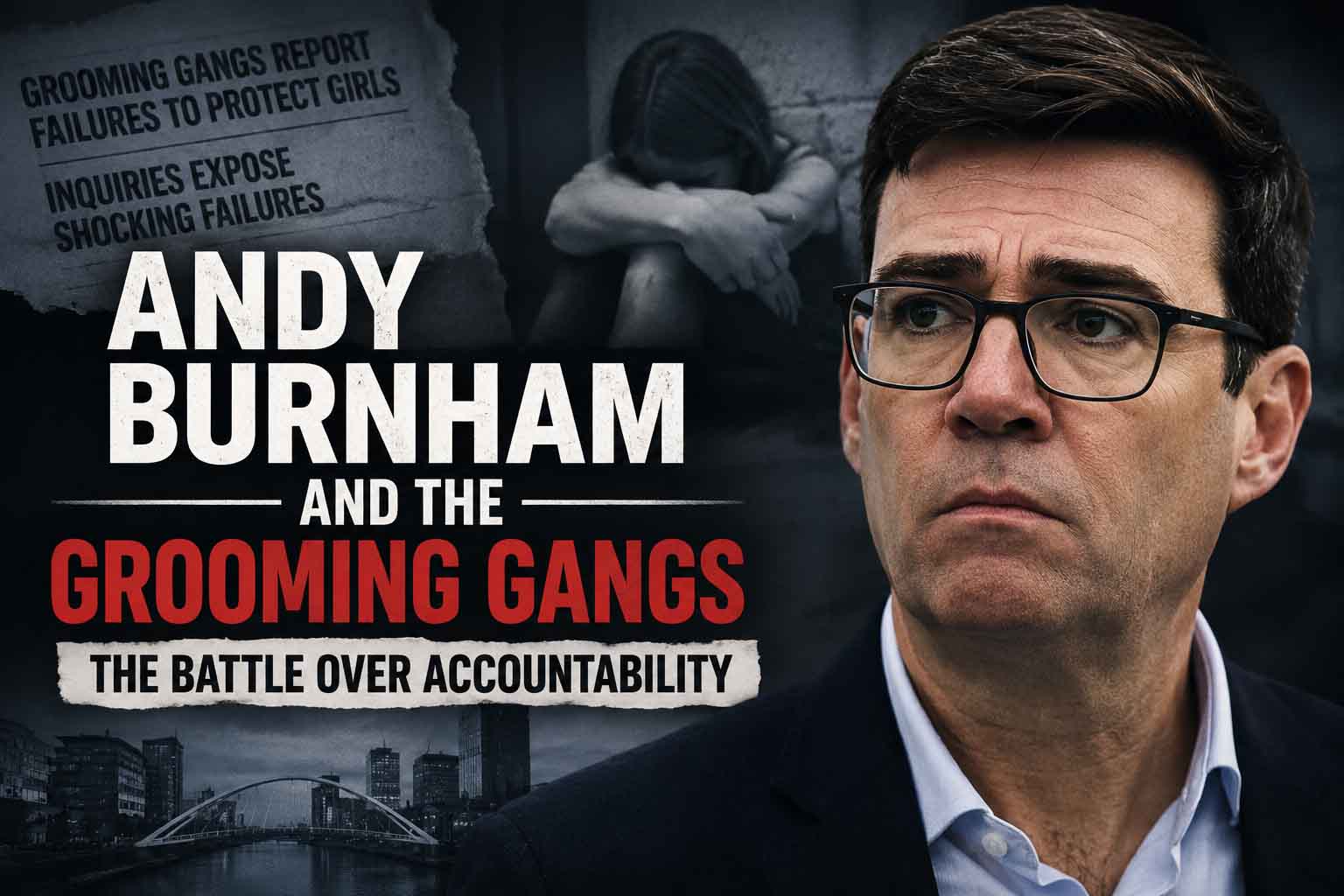
Andy Burnham and the Grooming Gangs
The Battle Over Accountability
Few issues in modern British politics are as emotionally charged as the grooming gangs scandal. The abuse suffered by vulnerable children in towns and cities across England represents one of the gravest safeguarding failures in recent history. Thousands of victims were failed by the institutions that were supposed to protect them, while perpetrators were allowed to continue offending for years.
As debate over accountability continues, one political figure who remains at the centre of the controversy is Andy Burnham, the Mayor of Greater Manchester and a prominent figure within the Labour Party. Critics accuse Burnham of failing victims, resisting scrutiny and downplaying aspects of the scandal. Supporters argue that he has done more than most politicians to expose historic failings and seek justice for survivors.
The truth lies within a complex and often bitter political argument that continues to divide opinion.
The Background: A National Scandal
The grooming gangs scandal refers to a series of cases across England in which organised groups of men systematically sexually exploited children, often over many years. High-profile cases emerged in areas including Rochdale, Rotherham, Oldham, Telford and other towns.
Subsequent inquiries found repeated failures by police forces, councils, social services and other agencies. Victims were often dismissed, ignored or even blamed for their own abuse. Some were labelled as troublesome children rather than recognised as victims of serious sexual exploitation.
Numerous reviews have concluded that institutional failings allowed abuse to continue for years. Concerns have also been raised about whether fears of being accused of racism contributed to a reluctance among some authorities to confront patterns involving groups of offenders from particular ethnic backgrounds. (The Guardian)
Burnham’s Intervention
When Andy Burnham became Mayor of Greater Manchester in 2017, he commissioned reviews into historical child sexual exploitation cases across the region.
These reviews examined failures in Manchester, Rochdale and Oldham. They uncovered significant shortcomings by public authorities and produced highly critical findings about how victims had been treated.
The reviews revealed serious failures by police and councils, while highlighting the devastating impact on survivors. Burnham’s supporters point to these investigations as evidence that he was willing to confront uncomfortable truths and challenge institutions that had previously failed children. (YouTube)
In Rochdale, an independent review concluded that girls had effectively been left vulnerable to abuse because of multiple institutional failures. Similar concerns emerged elsewhere across Greater Manchester. (YouTube)
Why Critics Remain Unconvinced
Despite commissioning reviews, Burnham has continued to face criticism from campaigners, survivors and some whistleblowers.
One of the most prominent critics has been former Greater Manchester Police detective Maggie Oliver, who played a key role in exposing grooming gang abuse. She has argued that while Burnham initially showed courage in reopening investigations, he ultimately failed to deliver the level of accountability that survivors expected.
Critics claim that some reviews did not go far enough, failed to compel key witnesses to give evidence and stopped short of fully exposing the extent of institutional failings.
More recently, Burnham has again come under scrutiny amid renewed political debate over national investigations into grooming gangs. Whistleblowers and campaigners have argued that survivors still do not feel their voices have been fully heard and that significant questions remain unanswered. (The Times)
The National Inquiry Debate
One of the most contested claims circulating online is that Burnham attempted to block a national inquiry into grooming gangs.
The public record paints a more complicated picture.
In January 2025, Burnham publicly supported a national inquiry, arguing that local reviews lacked the legal powers necessary to compel witnesses and obtain evidence. He stated that a national investigation could achieve things that local reviews could not. Later, he welcomed the Government’s decision to establish a statutory national inquiry. (The Guardian)
This does not mean his position escaped criticism. Some campaigners argued that support came too late, while others believed he should have demanded a full inquiry much earlier. However, the evidence does not support the straightforward claim that he opposed or blocked a national inquiry once the issue became a major national political debate. (The Guardian)
Are Grooming Gangs a Problem of the Past?
Another major point of disagreement concerns whether organised child sexual exploitation remains an active problem.
Recent reports indicate that it does.
Greater Manchester Police have reported hundreds of active investigations involving large numbers of victims and suspects. Inspectors reviewing the force’s work found that significant progress had been made but acknowledged that trust among some survivors remained severely damaged. (Sky News)
Meanwhile, survivor groups and campaigners continue to argue that organised child sexual exploitation remains a current threat rather than simply a historical issue. Recent documentaries, inquiries and investigations have highlighted ongoing concerns regarding child exploitation, both online and offline. (The Times)
This ongoing reality helps explain why the issue continues to provoke such strong emotions among survivors and the wider public.
Language and the Victims
One criticism that has generated particular anger concerns the language used to describe victims.
Campaigners argue that referring to victims as “young women” rather than children risks obscuring the fact that many were underage girls when the abuse occurred. For survivors and their advocates, language matters because it shapes how society understands responsibility and victimhood.
Whether particular comments were intended to minimise abuse remains disputed. However, the broader concern reflects a long-standing criticism of how institutions historically treated victims, often portraying them as troublesome teenagers rather than children subjected to systematic exploitation. Reviews into the scandals have repeatedly identified victim-blaming attitudes among authorities. (The Times)
The Political Consequences
As Andy Burnham’s national profile has grown, scrutiny of his record has intensified.
Supporters argue that he took action where others failed, commissioning investigations that exposed serious institutional shortcomings and helped drive reform. Critics argue that he has not gone far enough and should bear greater responsibility for unresolved questions surrounding historic abuse.
The disagreement reflects a wider national argument about accountability. Should political leaders be judged by the fact that they exposed failings, or by whether they fully satisfied survivors’ demands for justice?
For many victims, the answer is straightforward. They believe that exposing failures is only the beginning. Genuine accountability requires identifying every individual and institution that failed vulnerable children and ensuring that such failures can never happen again.
Conclusion
The grooming gangs scandal remains one of the darkest chapters in modern British public life. The suffering endured by victims cannot be undone, and the search for accountability continues.
Andy Burnham’s role remains fiercely contested. It is undeniable that reviews commissioned during his mayoralty exposed serious failures by public authorities. It is equally true that critics, including survivors and whistleblowers, continue to argue that more should have been done and that key questions remain unanswered.
As national inquiries continue and further evidence emerges, the debate surrounding Burnham’s record is unlikely to disappear. What remains beyond dispute is that the victims deserve the truth, justice where possible, and confidence that future generations of children will be better protected than they were.
Sources used include reporting on the Greater Manchester reviews, Burnham’s support for a national inquiry, police investigations into ongoing exploitation cases, and survivor testimony regarding institutional failures. (Greater Manchester Combined Authority)