

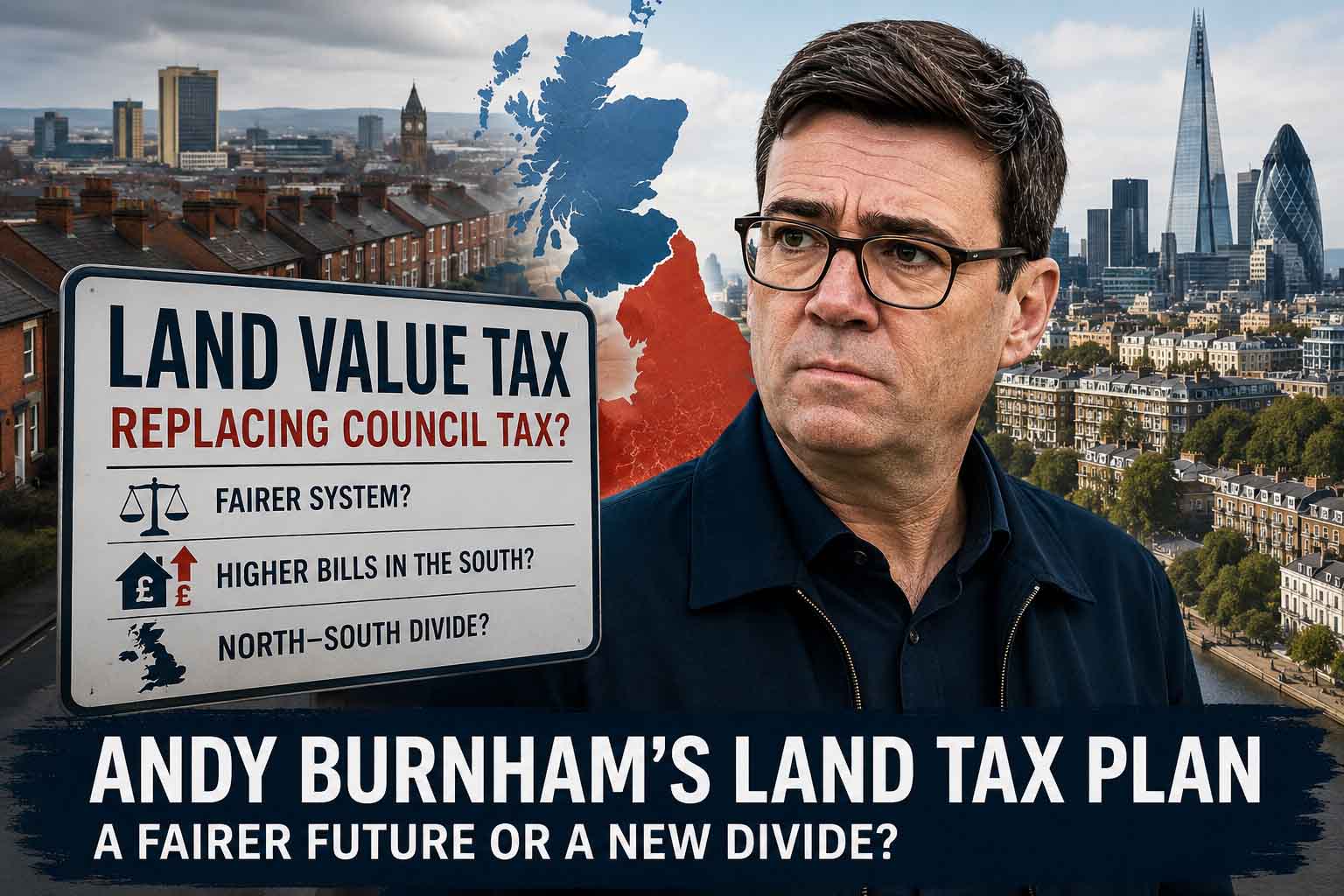
Andy Burnham’s Land Value Tax Proposal Reignites Britain’s North-South Divide
Andy Burnham’s renewed support for a Land Value Tax (LVT) has thrust one of Britain’s most controversial fiscal ideas back into the political spotlight, sparking debate over fairness, regional inequality and the future of local government finance.
The Greater Manchester Mayor, who is widely viewed as a potential future Labour leader, has long argued that the UK’s tax system places too much emphasis on work and income while failing to capture the growing wealth tied up in land ownership. In recent weeks, Burnham has again suggested that land in Britain is “undertaxed” and has called for a fundamental rethink of property taxation, including the possibility of replacing council tax with a land-based levy. (Financial Times)
The proposal has drawn fierce criticism from opponents, who argue that any move towards a Land Value Tax would disproportionately affect homeowners in London and the South East, where land values have risen dramatically over recent decades.
What Is a Land Value Tax?
Unlike council tax, which is based on property valuations that in England still rely on estimates from 1991, a Land Value Tax is levied on the value of the land itself rather than the buildings constructed upon it.
Supporters argue that land values largely arise from public investment, economic activity and planning decisions rather than the efforts of individual landowners. As a result, they contend that taxing land is one of the most economically efficient forms of taxation because land cannot be moved offshore, hidden or withdrawn from use. The concept has attracted support from economists across the political spectrum for decades. (House of Commons Library)
Burnham’s support for the idea is not new. As far back as 2010, he advocated replacing stamp duty with a Land Value Tax and suggested that inheritance tax could also be abolished as part of a broader restructuring of the tax system. (The Guardian)
More recently, he has described land taxation as “the first step out” of what he considers a broken fiscal model and has argued that local government requires greater fiscal autonomy to capture increases in land value generated by public investment. (LGC Plus)
Why Critics Are Concerned
The latest controversy was triggered by claims circulating on social media that replacing council tax with a Land Value Tax could lead to dramatic increases in annual bills in some parts of London.
Critics point out that while council tax bands are only loosely related to current property values, an LVT would directly reflect the market value of land. Since land in central and suburban London is often worth many times more than equivalent plots elsewhere in England, households in the capital could face substantially higher charges than those in northern regions.
This concern reflects a broader political reality. Any genuinely revenue-neutral Land Value Tax would inevitably create winners and losers. Areas with lower land values could benefit from lower bills, while regions with the highest land values would bear a larger share of the tax burden. Research examining potential LVT models for London has demonstrated significant variations in liabilities between boroughs depending on local land prices. (the University of Bath’s research portal)
Opponents also raise concerns about so-called “asset-rich but income-poor” households. Pensioners and long-term homeowners living in areas that have experienced rapid price growth could find themselves facing larger tax liabilities despite having relatively modest incomes.
The Economic Case for Reform
Supporters of Land Value Taxation argue that these criticisms overlook the deeper flaws within the current system.
Council tax is frequently criticised as regressive because properties worth several million pounds can attract only modestly higher bills than homes worth a fraction of that amount. The tax is also based on property valuations that are now more than three decades out of date in England. Meanwhile, stamp duty is widely criticised for discouraging people from moving home, reducing labour mobility and distorting the housing market. (The Guardian)
Advocates argue that taxing land rather than transactions or improvements would encourage more productive use of land, discourage speculative land banking and reduce economic distortions. Some economists also argue that shifting taxation from labour towards wealth and land ownership could support economic growth while broadening the tax base. (House of Commons Library)
The idea has gained renewed attention amid growing concerns over housing affordability and the concentration of wealth in property ownership.
A Political Challenge for Labour
While Land Value Taxation enjoys support among economists and policy reformers, translating the theory into practical politics remains difficult.
The proposal cuts directly across Britain’s entrenched regional divides. Many voters in London and the South East already contribute significantly through income tax and other national taxes, making them wary of reforms that could further increase their financial burden. Conversely, supporters argue that current property taxation favours areas where land values have risen dramatically and that reform is overdue.
Online reaction to Burnham’s comments reflects this divide. Some commentators support replacing council tax and stamp duty with a revenue-neutral Land Value Tax, while others fear it would simply become an additional tax layered onto the existing system. Concerns have also been raised about the impact on households whose property values have risen faster than their incomes. (Reddit)
For Burnham, the debate is likely to become increasingly significant if he pursues a return to Westminster or mounts a future Labour leadership campaign. His argument forms part of a wider vision that seeks to shift taxation away from earned income and towards wealth, assets and property. (Financial Times)
Conclusion
The debate over Land Value Taxation ultimately raises a fundamental question about fairness in modern Britain: should taxation focus more heavily on wealth accumulated through rising land values, or should policymakers avoid reforms that could impose significant new costs on homeowners in high-value regions?
Andy Burnham believes the answer lies in taxing land more effectively and modernising a council tax system rooted in 1991 valuations. Critics believe such reforms risk creating a new divide between North and South while penalising homeowners who may be wealthy on paper but not in practice.
As pressure grows for reform of local government finance and property taxation, the argument over Land Value Tax may move from an academic discussion to one of the defining political battles of the coming decade.
This version is written in a neutral, professional news-analysis style suitable for a political affairs website, news outlet, or current affairs blog.