

Is the UK’s Real Problem a Productivity Crisis?
For years, Britain’s economic debate has centred on inflation. Rising prices, higher mortgage costs and the increasing cost of living have dominated headlines and political discussion. Yet some economists and commentators argue that inflation is merely a symptom of a deeper structural challenge facing the United Kingdom.
At the heart of the argument is a simple question: how many people are actively generating the economic output and tax revenues needed to support the country’s growing demands on public services and welfare spending?
Breaking Down the Numbers
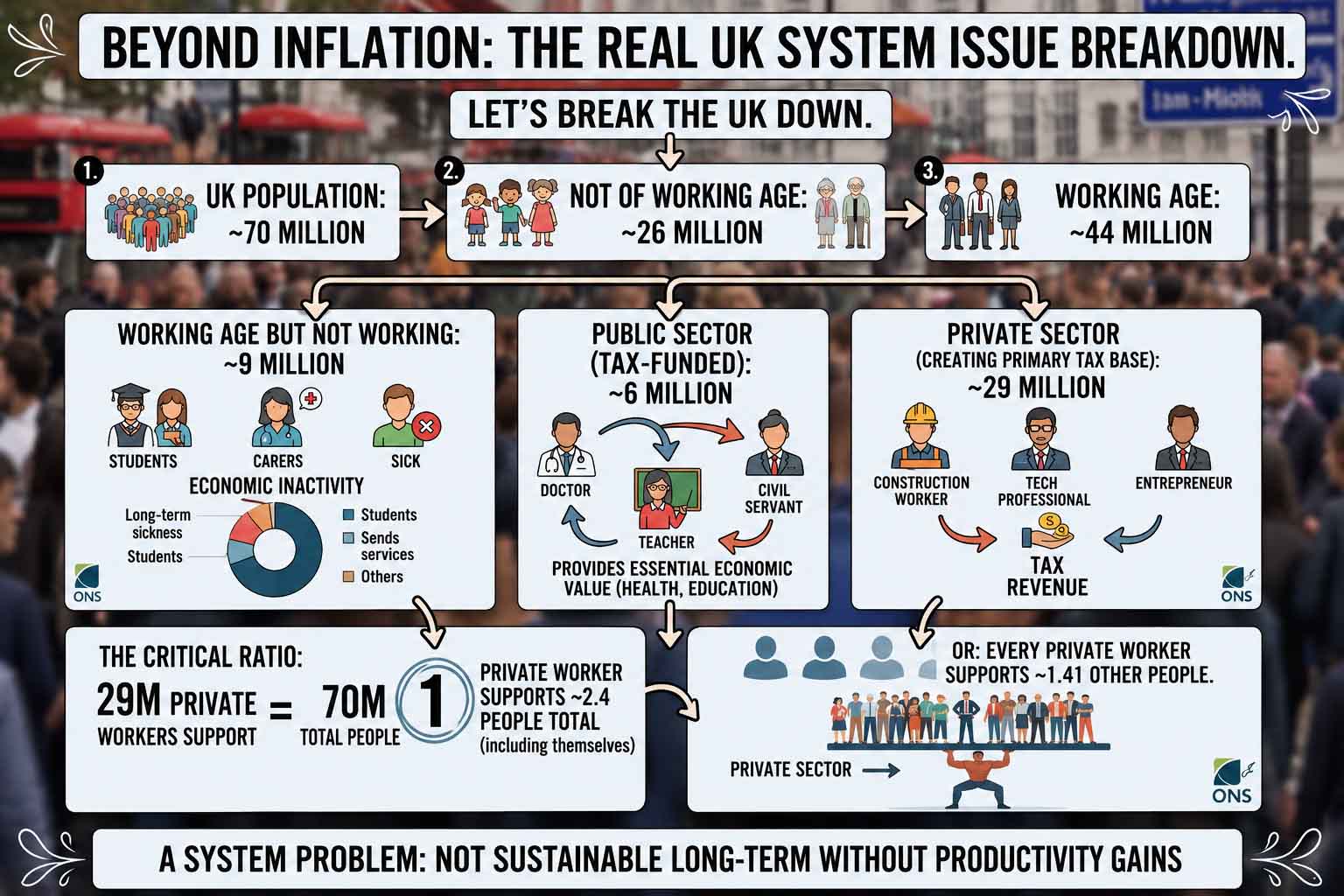
The UK population now stands at around 70 million people. Of these, approximately 26 million are either below working age or have reached retirement age, leaving roughly 44 million people of working age.
However, not everyone of working age is employed. Around 9 million people fall into categories commonly described as economically inactive. This group includes students, unpaid carers, those suffering from long-term illness and others who are not currently participating in the labour market.
That leaves two broad groups making up the employed workforce.
The first is the public sector, comprising approximately six million workers. These include doctors, nurses, teachers, police officers, local authority staff and civil servants. Their work is essential to the functioning of society, providing healthcare, education, security and public administration.
The second is the private sector, which employs around 29 million people. These workers and businesses generate much of the country’s economic output and contribute significantly to the tax base through income tax, corporation tax, VAT and other forms of taxation.
The Ratio That Raises Questions
Supporters of the productivity-focused argument highlight a striking ratio.
With approximately 29 million private-sector workers supporting a population of around 70 million people, each private-sector employee is effectively linked to the economic support of around 2.4 people when the entire population is considered.
Put another way, every private-sector worker supports themselves and approximately 1.4 other people through the wider economic and tax system.
The argument is not that public-sector workers or economically inactive individuals lack value. Far from it. Teachers educate future workers, healthcare professionals maintain the nation’s health and carers provide vital support that would otherwise place greater strain on public services.
Instead, the concern is whether the balance between productive economic output and growing demands on public expenditure is becoming increasingly difficult to sustain.
A Changing Economic Landscape
Several long-term trends have intensified this debate.
Britain’s population is ageing. People are living longer, increasing demand for healthcare, pensions and social care. At the same time, birth rates have fallen, reducing the number of younger workers entering the labour market.
Economic inactivity has also risen in recent years, driven partly by long-term health conditions and the lingering effects of the pandemic. According to official statistics, long-term sickness remains one of the largest contributors to economic inactivity among working-age adults.
Meanwhile, productivity growth has remained stubbornly weak. Productivity – the amount of economic output generated per worker – is widely regarded as the key driver of long-term prosperity. When productivity rises, wages can increase without fuelling inflation, businesses become more competitive and governments collect more tax revenue without raising tax rates.
The UK’s productivity growth has largely stagnated since the 2008 financial crisis, creating what many economists describe as Britain’s “productivity puzzle”.
Why Productivity Matters More Than Population
The infographic’s central claim is that the UK’s challenge cannot be solved simply by increasing the size of the population or expanding public spending.
Historically, rising living standards have been driven by workers becoming more productive through technological innovation, better infrastructure, improved education and greater investment.
A single worker today can produce far more than a worker could a century ago, not because they work harder, but because they have access to better tools, technology and systems.
If productivity growth remains weak while demands on healthcare, pensions and public services continue to increase, governments face difficult choices. These typically involve some combination of higher taxation, increased borrowing, reduced spending or economic reforms aimed at stimulating growth.
The Counterargument
Critics of the infographic’s framing argue that the picture is more complex than a simple division between private-sector workers and everyone else.
Public-sector employees pay taxes and contribute directly to economic activity. Without healthcare, education, policing and infrastructure, private businesses would struggle to operate effectively.
Likewise, many pensioners continue contributing through taxation, volunteering, childcare and unpaid support for families. Students represent future economic capacity rather than a long-term burden, while carers save the state billions of pounds annually through unpaid work.
Furthermore, government revenues are not generated solely through private-sector wages. Corporation tax, investment income, capital gains and consumption taxes all play significant roles in funding public services.
The Bigger Question
Despite these caveats, the infographic succeeds in highlighting an issue that is increasingly central to Britain’s economic future.
Whether viewed through the lens of public finances, healthcare pressures, housing shortages or living standards, many of the UK’s challenges ultimately return to one fundamental question: how can the country generate more economic output with the resources available?
If Britain can improve productivity through investment, innovation, skills development and technological advancement, it may be possible to maintain public services and rising living standards without imposing ever-greater burdens on taxpayers.
If productivity remains stagnant, however, the pressures created by an ageing population, increasing healthcare demands and slower economic growth are likely to become more acute.
The debate, therefore, may not be about inflation at all. Inflation is often the visible symptom. Productivity, demographics and economic participation may be the underlying causes that determine Britain’s long-term prosperity.
As policymakers search for solutions, the real challenge may be ensuring that economic growth keeps pace with the demands placed upon it.