

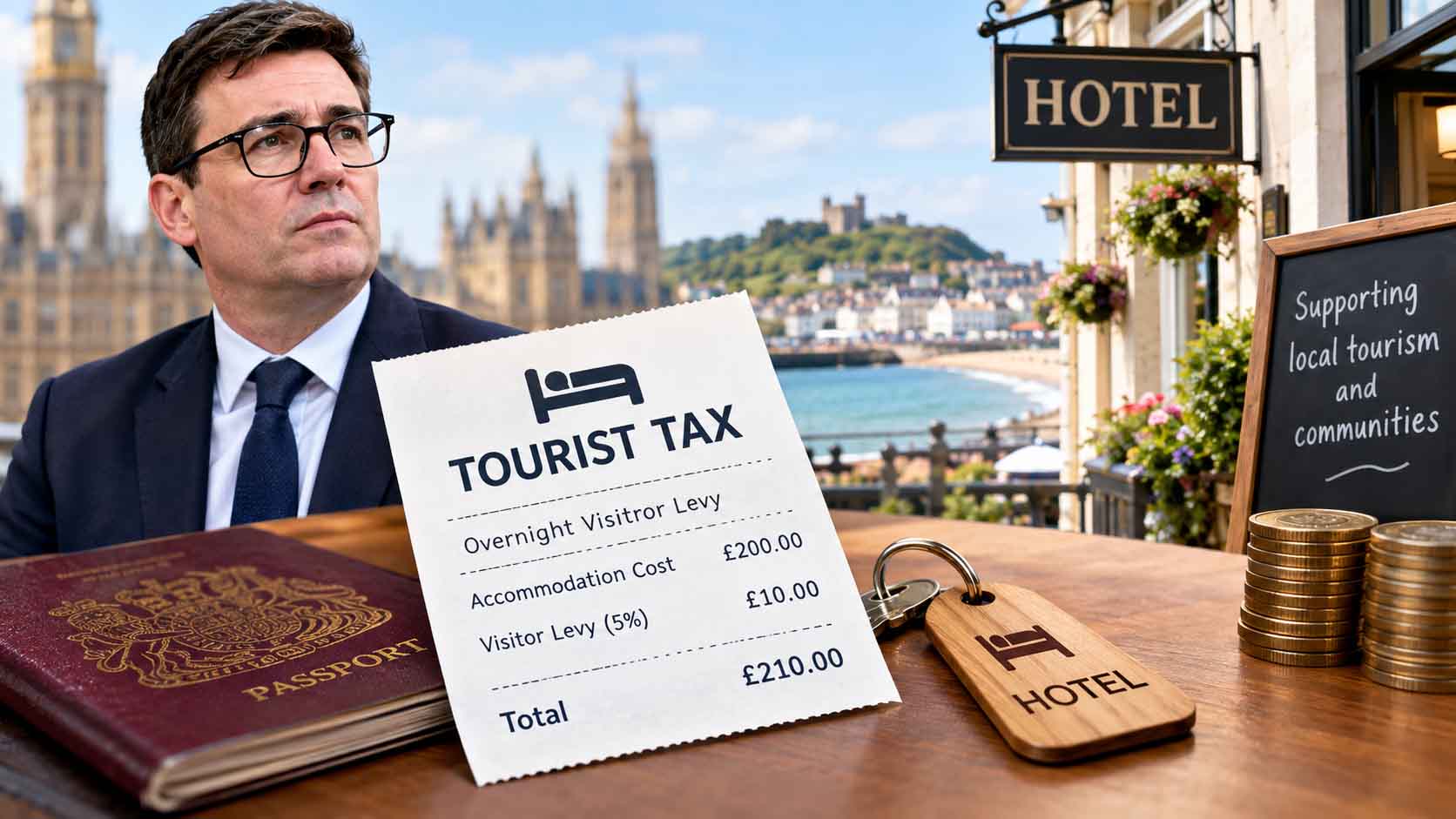
Burnham’s tourist tax threatens the hospitality industry
The Government’s decision to give mayors and other strategic authorities in England the power to introduce an Overnight Visitor Levy marks a significant change in the way local government can raise revenue. Supporters describe the measure as an important step towards fiscal devolution, allowing local leaders to benefit financially from the visitors their areas attract.
For the hospitality industry, however, the announcement represents a serious new threat.
The central concern is not simply the existence of a visitor levy. Tourist taxes already operate in many destinations around the world, including parts of the UK. The controversy surrounding the English model is that local authorities will have substantial discretion over the rate, while the Government has chosen not to impose a national maximum.
For hotels, B&Bs, holiday lets, holiday parks and the millions of people who rely on tourism, that creates considerable uncertainty.
A new tax on overnight stays
The Government has been developing the Overnight Visitor Levy since 2025, when it consulted on giving Mayoral Strategic Authorities the power to introduce a charge on paid overnight accommodation. The consultation considered issues including which forms of accommodation would be covered, how rates would be calculated, how the revenue could be spent and how the levy would be administered. (GOV.UK)
The policy is now moving towards implementation as part of the Government’s wider programme of English devolution.
Under the emerging framework, local leaders will be able to decide whether a visitor levy is appropriate for their area. The charge is expected to be calculated as a percentage of the accommodation cost, rather than a fixed amount per person or room.
The Government argues that this is a fairer approach because a percentage-based levy means that cheaper accommodation attracts a smaller charge. It has previously described a flat-rate model as potentially regressive because the same charge would be imposed regardless of the price of the accommodation. (GOV.UK)
But the percentage model also means that the amount paid rises with the price of the accommodation.
And, crucially, there will be no centrally imposed national cap on the rate under the plans being announced.
That is the aspect that has alarmed the hospitality sector.
Why Andy Burnham is at the centre of the debate
The policy is not, strictly speaking, a tax personally imposed by Andy Burnham. It is a UK Government policy forming part of its broader devolution programme.
However, Burnham has become closely associated with the idea because of his experience as Mayor of Greater Manchester and his long-standing support for greater fiscal powers for regional leaders.
Greater Manchester introduced a £1-per-room-per-night City Visitor Charge in 2023 through its Accommodation Business Improvement District arrangements.
The new national framework is much more significant. It could potentially allow strategic authorities across England to introduce statutory visitor levies covering a much wider range of accommodation.
The Government itself describes the measure as a new tool for local leaders to raise and invest money in projects that improve their areas, raise living standards and drive economic growth. (GOV.UK)
That makes the policy an important component of the Government’s wider attempt to move financial and political power away from Westminster.
But devolution inevitably raises another question:
What happens when greater local financial freedom means greater local taxation?
The Government’s argument
Ministers argue that tourism places additional demands on local infrastructure.
Visitors use roads and public transport, generate waste, increase demand for public services and benefit from cultural, environmental and leisure infrastructure that local authorities have to maintain.
A visitor levy, therefore, allows some of the cost of providing those services to be recovered from the people benefiting from them.
The Government also argues that tourism taxes are already commonplace internationally. Its original proposal highlighted cities such as New York, Paris and Milan as examples of destinations where charges on short-term visitors are used to support local investment. (GOV.UK)
There is also a strong economic argument for giving local authorities the power.
If a city invests additional revenue in transport, public spaces, events, cultural attractions and tourism marketing, it could potentially attract more visitors, generating further economic activity for hotels, restaurants, pubs, shops and attractions.
The Centre for Cities has therefore welcomed the policy as an important step towards fiscal devolution, arguing that places should have greater control over the money they raise and the ability to invest in their own economic potential. (The Guardian)
That argument is not without merit.
The problem is what happens if the levy becomes too high.
The hospitality industry’s warning
UKHospitality has mounted strong opposition to the proposal.
Its modelling suggests that a 5% visitor levy could result in:
- £1.78 billion less tourism spending;
- 11.87 million fewer nights spent in accommodation;
- around 33,000 jobs lost;
- £101 million less direct investment; and
- an additional cost of at least £100 for a typical family holiday. (UKHospitality)
Those figures are industry modelling rather than Government forecasts, and they should therefore be treated as a projection rather than a guaranteed outcome.
Nevertheless, they illustrate the scale of the industry’s concern.
UKHospitality argues that the sector is already operating under considerable pressure. Accommodation businesses in Britain face a VAT rate of 20%, significantly higher than that found in many competing European tourism markets.
Adding another charge to the cost of staying in Britain could therefore make the UK less competitive at precisely the time when businesses are trying to recover from years of economic disruption and rising operating costs.
The organisation has proposed an alternative: rather than taxing visitors, central Government could distribute additional funding to local authorities according to the number of visitors they attract.
It calls this approach a “holiday bonus”, arguing that it would reward destinations for attracting tourism rather than potentially penalising the businesses that provide it. (UKHospitality)
Could the tax make British holidays more expensive?
Almost certainly.
The question is by how much.
Because the English levy is expected to be percentage-based, the impact will depend entirely on the rate chosen by individual authorities.
For illustration, a 5% levy would mean:
| Accommodation cost | 5% levy |
|---|---|
| £80 | £4 |
| £120 | £6 |
| £200 | £10 |
| £300 | £15 |
| £500 | £25 |
For a single night’s accommodation, these amounts may appear relatively modest.
But a family staying for a week in a £200-per-night hotel would face an additional £70 at 5%.
For more expensive accommodation, or longer holidays, the additional cost could become considerably larger.
And if one authority ultimately chose a rate above 5%, the impact would increase correspondingly.
This is why the absence of a national cap is so important.
Edinburgh offers a warning—and a comparison
England will not be the first part of the UK to introduce a visitor levy.
Edinburgh introduced Scotland’s first visitor levy in July 2026, charging 5% of the cost of overnight accommodation, with the charge applying for a maximum of five nights.
The Scottish model therefore provides an important comparison.
At 5%, Edinburgh’s levy is substantial but clearly defined. Visitors and businesses know the maximum rate and the maximum number of nights for which it can apply.
England’s proposed model is different.
The Government intends to give local authorities considerable discretion, and there is no equivalent national maximum rate.
That creates the possibility of substantial differences between neighbouring destinations.
One area could decide that a levy of 3% is appropriate. Another could choose 5%. Another might decide that it needs more revenue and impose a higher rate.
For businesses operating across several regions, that could create a complicated patchwork of different taxation systems.
Wales has chosen a different approach
Wales has also legislated for a visitor levy, but its model is more tightly defined.
Welsh local authorities will be able to introduce a charge of £1.30 per person per night for most forms of visitor accommodation, with a lower rate applying to certain accommodation such as hostels and campsites.
The Welsh system therefore differs fundamentally from the emerging English model.
England is moving towards a percentage-based charge determined locally.
Wales is using a nationally defined per-person nightly rate.
Scotland has given councils the ability to introduce local schemes, with Edinburgh opting for 5% with a five-night maximum.
There is therefore no single UK-wide approach to tourism taxation.
The danger of a race to raise revenue
The most serious criticism of the English model is not necessarily that a visitor levy exists.
It is that once the power has been granted, there could be pressure on local authorities to increase the rate whenever budgets become strained.
That creates a potential conflict of interests.
A mayor or strategic authority may want to keep the levy low to support tourism and local businesses.
At the same time, that same authority may face enormous financial pressures and see visitors as a relatively easy source of additional revenue.
The temptation could be obvious.
Visitors do not vote in the same way as permanent residents. A tourist staying for three nights has no direct electoral influence over the mayor deciding the levy.
That makes tourism taxation politically attractive.
But what is attractive to a local treasury may not necessarily be attractive to the businesses that depend on visitors.
Coastal and rural communities could be particularly exposed
The impact will not be evenly distributed across England.
Major cities with strong international tourism, business travel and conference industries may be better placed to absorb additional charges.
Smaller coastal and rural communities could be much more vulnerable.
Many operate with narrow profit margins and depend heavily on seasonal tourism.
A family choosing between a £1,000 domestic holiday and a similarly priced overseas trip may react differently to an additional tax than a business traveller staying in a major international city.
There is also a wider economic effect.
Visitors do not simply spend money on accommodation.
They spend money in:
- restaurants;
- pubs;
- cafés;
- attractions;
- museums;
- entertainment venues;
- shops;
- taxis;
- leisure facilities; and
- local transport.
If a visitor spends more on accommodation because of taxation, they have less money available for those other businesses.
That is the industry’s central argument: the economic impact of a visitor levy cannot be measured simply by the amount collected by the authority.
A tax can raise money while still costing the economy
This is an important distinction.
Suppose a local authority collects £50 million from a visitor levy.
On paper, that appears to be £50 million of additional revenue.
But if the tax causes visitors to shorten their stays, cancel trips, choose cheaper accommodation or spend less in restaurants and attractions, the wider economy could lose considerably more than the authority gains.
That is precisely what UKHospitality’s modelling attempts to demonstrate.
Its analysis estimates that a 5% levy could produce a £1.6 billion increase in taxation, while reducing GDP by approximately £2.2 billion. (Financial Times)
Again, these are industry projections rather than established outcomes.
But they highlight a legitimate policy question:
Is increasing local tax revenue necessarily the same thing as increasing local prosperity?
The answer will depend heavily on how the levy is designed and what authorities do with the money.
Where the money goes will matter
There is a potentially persuasive case for a visitor levy if the revenue is clearly linked to tourism.
If visitors can see that their money is funding cleaner streets, better transport, improved public spaces, cultural events, visitor attractions and infrastructure, they may be more willing to accept the charge.
The Government says revenue from the levy can be invested in local priorities, including transport, infrastructure and the visitor economy. (GOV.UK)
But if visitors believe the money is simply disappearing into general council budgets, resentment is likely to grow.
Transparency will therefore be critical.
Local authorities should arguably publish:
- how much the levy raises;
- how much it costs to administer;
- exactly where the money is spent;
- what measurable benefits it produces; and
- whether visitor numbers and tourism spending have increased or declined.
Without such transparency, the levy risks becoming viewed simply as another local tax.
A difficult balance for mayors
There is a strong argument for giving local leaders greater financial autonomy.
England has long been one of the most centralised countries in Europe, and successive governments have promised to move power away from Westminster.
Allowing regions to raise and spend some of their own money could make local government more accountable and encourage leaders to develop policies suited to their own economies.
But fiscal devolution also means tax devolution.
If mayors want the freedom to raise money locally, they must also accept responsibility for the economic consequences of doing so.
A successful visitor levy should therefore be designed to encourage tourism rather than simply extract money from it.
The Government faces a crucial test
The Overnight Visitor Levy is now becoming a reality rather than a theoretical proposal.
The Government’s wider devolution programme envisages strategic authorities taking on significantly greater responsibilities, with additional powers and funding intended to give local leaders greater control over economic development. (GOV.UK)
The visitor levy is part of that broader experiment.
Its success will ultimately depend on whether mayors exercise restraint.
A modest, transparent levy that is clearly invested back into the visitor economy could potentially work.
An aggressive tax imposed primarily to plug holes in local finances could have very different consequences.
For the hospitality industry, the fear is that once the power exists, there will be little to prevent future leaders from increasing the rate.
That is why the absence of a national ceiling has become such a contentious issue.
The real question is whether Britain wants to tax tourism or grow it
Britain already has a major tourism industry supporting hundreds of thousands of jobs and thousands of businesses.
Hotels, guest houses, holiday parks, pubs, restaurants and attractions are not simply providers of leisure. They are major employers and contributors to local economies.
The Government is therefore attempting to achieve two potentially conflicting objectives: increase local revenue while simultaneously promoting economic growth and tourism.
Whether those objectives can coexist will depend on the tax rate, how frequently it changes, which businesses are covered and—most importantly—what happens to visitor behaviour.
The hospitality industry’s warning should not automatically be accepted as fact. Its job-loss and economic-impact figures are forecasts based on modelling, and supporters of the levy have a legitimate argument that properly designed visitor charges can support successful destinations.
But equally, the Government should not assume that because tourist taxes operate successfully elsewhere, another tax will automatically work in every part of England.
The danger is that a policy intended to give regions greater economic freedom could instead make British holidays more expensive, weaken hospitality businesses and reduce the very tourism that local leaders are trying to encourage.
The Government has chosen to give mayors the power.
The responsibility now rests with those mayors to prove that they can use it without taxing the hospitality industry into decline.