

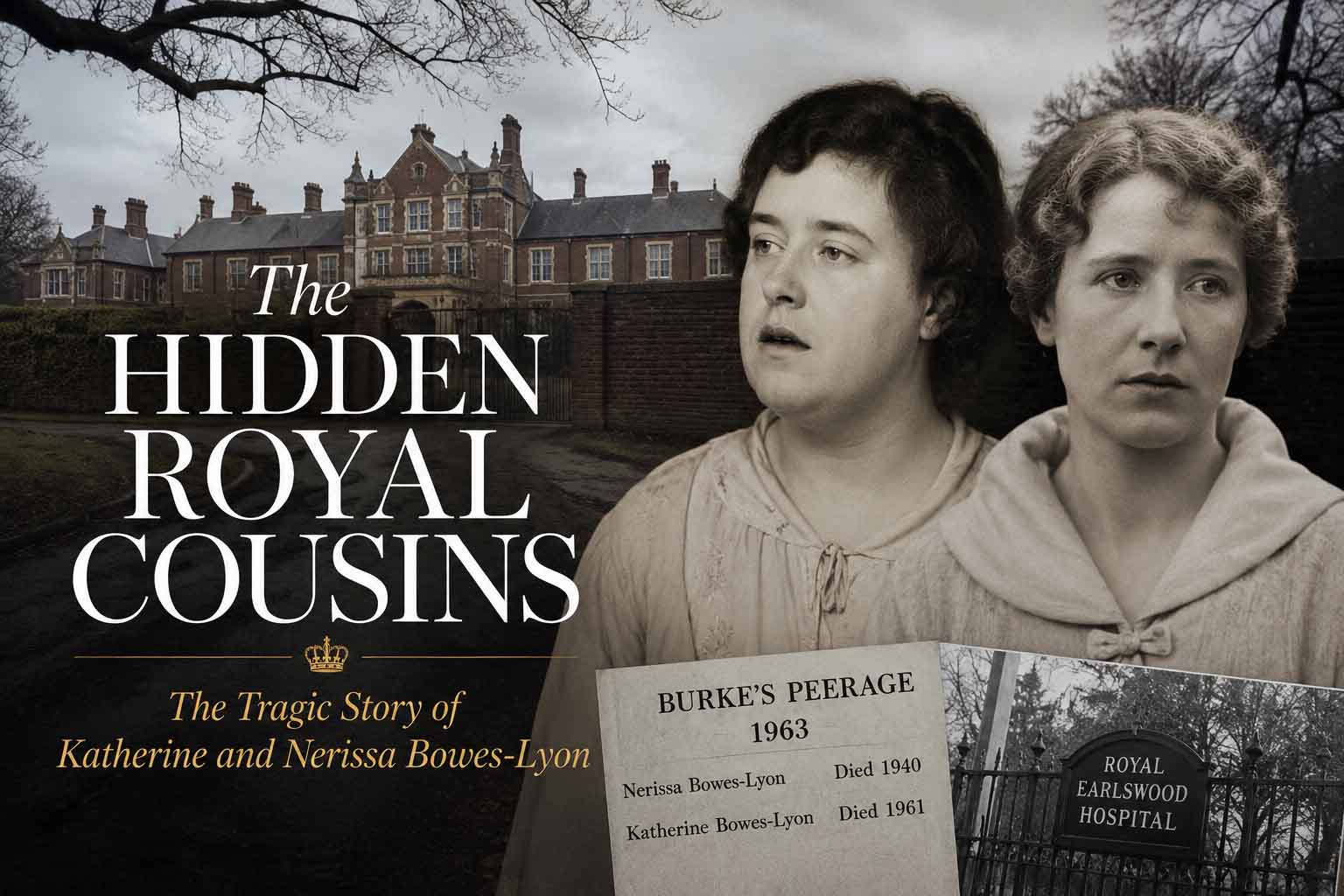
The Hidden Royal Cousins
The Tragic Story of Katherine and Nerissa Bowes-Lyon
For more than four decades, two close relatives of the British Royal Family lived almost entirely forgotten behind the walls of a psychiatric institution. Their existence remained unknown to the public until an explosive newspaper investigation in April 1987 revealed that they had been declared dead while still alive.
The story of Katherine and Nerissa Bowes-Lyon remains one of the most controversial episodes in modern royal history, raising enduring questions about disability, social stigma and the treatment of vulnerable family members during the twentieth century.
A Family Connection to the Throne
Katherine and Nerissa Bowes-Lyon were the daughters of John Herbert Bowes-Lyon, the elder brother of Queen Elizabeth, later known as the Queen Mother.
As a result, the sisters were maternal first cousins of Queen Elizabeth II and Princess Margaret. Although they were not members of the Royal Family itself, they belonged to one of Britain’s most prominent aristocratic families.
Living with Severe Disabilities
Both sisters were born with profound intellectual and developmental disabilities. Contemporary medical records described them using terminology that is now recognised as deeply offensive and outdated, reflecting the medical attitudes of the era rather than modern understanding.
Neither woman learned to speak and both required lifelong care.
While no definitive diagnosis has ever been publicly established, the fact that three daughters of their mother’s sister, the Fane family, exhibited remarkably similar disabilities has led many geneticists to conclude that an inherited condition was likely responsible. Modern researchers have proposed several rare genetic disorders, although no diagnosis has ever been confirmed.
Admission to Royal Earlswood
In 1941, Katherine, aged 15, and Nerissa, aged 22, were admitted to the Royal Earlswood Hospital in Redhill, Surrey. Originally established as the Asylum for Idiots, Royal Earlswood specialised in caring for people with profound intellectual disabilities.
On the very same day, three of their maternal cousins from the Fane family were also admitted to the institution.
Today such a decision may appear shocking, but during the first half of the twentieth century institutional care was considered an accepted solution for many families caring for relatives with severe disabilities. Limited medical knowledge, a lack of community support and widespread social stigma meant that thousands of people across Britain spent much of their lives in similar institutions.
The Burke’s Peerage Mystery
The affair became truly controversial because of entries published in Burke’s Peerage, the respected directory of Britain’s aristocracy.
The 1963 edition recorded Nerissa as having died in 1940 and Katherine in 1961.
Neither entry was correct.
In reality, both women were still alive. Nerissa would remain at Royal Earlswood until her death in January 1986, while Katherine continued living there for many more years.
How these incorrect entries came to appear has never been fully resolved.
Members of the Bowes-Lyon family later insisted the information had been submitted in error by the sisters’ mother, Fenella Bowes-Lyon, and denied there had been any deliberate attempt to conceal their existence.
The Story That Shocked Britain
Everything changed on Monday, 6 April 1987.
The Sun newspaper published a front-page investigation under the headline “Queen’s Cousin Locked in Madhouse”, revealing that Katherine Bowes-Lyon was alive and living at Royal Earlswood despite being officially recorded as dead.
The report also disclosed that Nerissa had died only the previous year after spending more than four decades in institutional care.
The revelations quickly made international headlines and prompted widespread public criticism.
Buckingham Palace declined to comment, describing the matter as one for the Bowes-Lyon family.
Claims of Abandonment
The investigation also highlighted claims made by former hospital staff.
Several nurses stated they could not recall members of the family visiting the sisters during their years at Royal Earlswood. Others said they remembered no birthday cards or Christmas presents arriving from relatives.
Perhaps the most poignant detail concerned Nerissa’s funeral.
When she died on 22 January 1986, her funeral was attended only by hospital staff. She was buried in Redhill Cemetery with nothing more than a plastic identification marker bearing a serial number.
Following the publicity generated by the newspaper investigation, a permanent gravestone was later installed.
The Family’s Response
The Bowes-Lyon family strongly rejected suggestions of a deliberate cover-up.
Lady Elizabeth Anson maintained that there had been no conspiracy and that the inaccurate Burke’s Peerage entries resulted from administrative mistakes rather than intentional deception.
Some hospital officials also stated that family visits had taken place earlier in the sisters’ lives, although they acknowledged they had become infrequent over time.
Because documentary evidence is incomplete, historians continue to debate exactly how much contact existed between the sisters and their wider family.
Katherine’s Final Years
Royal Earlswood Hospital closed in 1997 as part of wider changes in the care of people with learning disabilities.
Katherine was transferred to a Surrey care home, where she remained until her death on 23 February 2014 at the age of 87.
Her passing marked the end of a story that had remained hidden from public view for nearly half a century.
Changing Attitudes Towards Disability
The Bowes-Lyon case is now widely regarded as an illustration of how attitudes towards disability have changed over the past century.
During the 1940s, long-term institutionalisation was considered acceptable medical practice for many people with profound intellectual disabilities. By the late twentieth century, public opinion had shifted dramatically towards inclusion, dignity and community-based care.
The revelation that two close relatives of the monarch had spent decades in an institution while official records listed them as deceased resonated far beyond royal circles. It prompted renewed debate about the treatment of disabled people, the pressures faced by prominent families and the culture of secrecy that often surrounded disability throughout much of the twentieth century.
Nearly four decades after The Sun exposed the story, Katherine and Nerissa Bowes-Lyon continue to symbolise a forgotten chapter in British social history—one that serves as a reminder of how profoundly society’s understanding of disability, compassion and human dignity has evolved.