

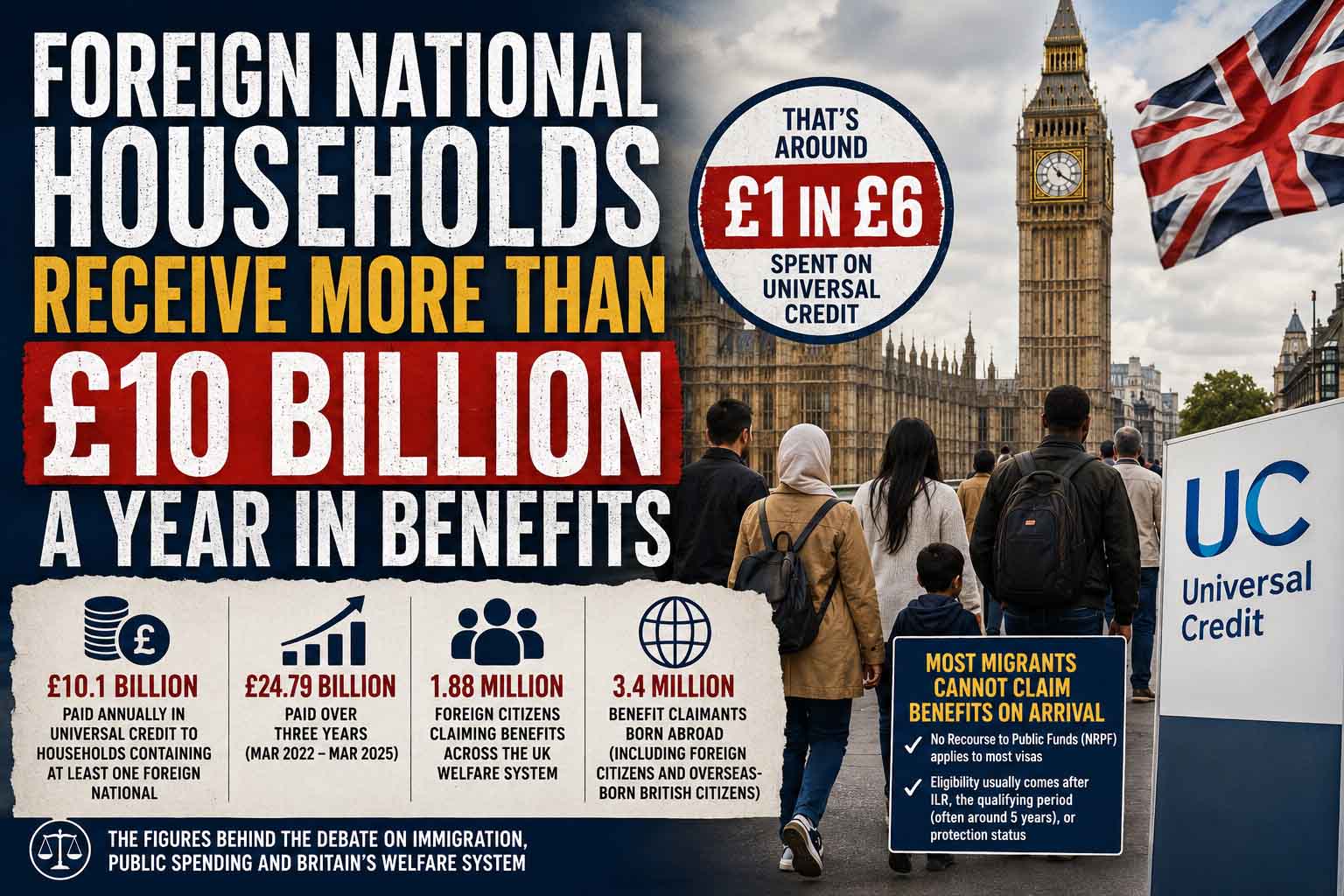
Foreign National Households Receive More Than £10 Billion a Year in Benefits
Official figures reveal that households containing foreign nationals account for around one in every six pounds spent on Universal Credit, while the majority of migrants remain ineligible for benefits when they first arrive in the UK.
The UK Government spends more than £10 billion each year on Universal Credit payments to households containing at least one foreign national, according to official Department for Work and Pensions (DWP) data.
The figures, obtained through Freedom of Information requests and reported by national newspapers, show that approximately £10.1 billion is paid annually to households where at least one claimant is neither a British nor an Irish citizen. This represents around 16.5 per cent of all Universal Credit expenditure, equating to roughly £1 in every £6 spent on the benefit.
The total has risen significantly in recent years. Annual expenditure increased from approximately £6.3 billion in 2022 to £7.9 billion in 2023, before reaching £10.1 billion in the latest figures.
On a monthly basis, payments to these households now amount to around £941 million.
Nearly £25 Billion Paid Over Three Years
Between March 2022 and March 2025, cumulative Universal Credit payments to households containing foreign nationals totalled approximately £24.79 billion.
The increase reflects both higher Universal Credit expenditure overall and a growing number of eligible migrant households claiming support.
Almost 1.9 Million Foreign Citizens Claim Benefits
Separate government data indicates there are approximately 1.88 million benefit claims involving foreign citizens across the UK welfare system.
These claims extend beyond Universal Credit and include support such as:
- Housing Benefit
- Disability benefits
- Child Benefit
- Pension Credit
- Other state welfare payments
The largest group of foreign-national claimants originally came to Britain for employment.
According to Labour Force Survey data, the breakdown includes:
- 663,000 who originally arrived to work
- 580,000 family dependants
- 179,500 former international students
- 144,000 refugees and asylum seekers who have subsequently become eligible for support
Foreign-Born British Citizens Increase the Total
The figures become substantially larger when considering everyone born outside the United Kingdom, rather than only foreign nationals.
An estimated 1.5 million British citizens who were born overseas also receive state benefits.
When combined with foreign citizens, this produces an estimated 3.4 million benefit claimants who were born abroad.
It is important to note that many of these individuals have lived and worked in Britain for many years, paid taxes and National Insurance contributions, and later acquired British citizenship.
Most Migrants Cannot Claim Benefits on Arrival
Despite the size of the overall spending, most migrants arriving in the UK are not immediately entitled to claim public funds.
The majority of work, study and family visas are issued with a condition known as No Recourse to Public Funds (NRPF). This prevents access to most means-tested benefits, including Universal Credit, Housing Benefit and other welfare payments.
In most cases, eligibility only becomes possible after an individual has:
- obtained Indefinite Leave to Remain (ILR);
- completed the required qualifying period, often around five years for many visa routes; or
- been granted refugee or humanitarian protection status.
Different immigration categories have different rules, and entitlement also depends on residence requirements and other eligibility criteria.
A Continuing Political Debate
The figures have become a significant issue in Britain’s wider debate over immigration, public spending and welfare policy.
Supporters of tighter immigration controls argue that the rapid increase in expenditure demonstrates the growing fiscal cost associated with migration and raises questions about the long-term sustainability of the welfare system.
Others point out that many foreign-born claimants have spent years contributing to the UK economy through employment and taxation before becoming eligible for support, while refugees and those granted humanitarian protection have legal entitlements under UK law.
The data illustrates the complexity of measuring welfare spending linked to migration. While annual Universal Credit payments to households containing foreign nationals now exceed £10 billion, the overwhelming majority of migrants remain ineligible for benefits during their initial years in Britain, and many recipients are long-term residents or naturalised British citizens who qualify under the same rules as UK-born citizens.
As immigration and welfare remain central political issues, these figures are likely to continue shaping public debate over how Britain’s benefits system should operate in the years ahead.
Additional Costs
These figures only include the benefits that are paid to foreign born people, it does not include the costs of interpreters, healthcare, the increasing burden of disabled children due to ‘cousin marriages’ the money invested in social schemes to try to cover up the crimes of immigrants, or to educate them, creating jobs for them at the expense of British people, not to mention the cost of crime, justice and incarceration.
There comes a time when we must ask if the country can afford this? How much more can be taken from those who contribute, before there are non left?