

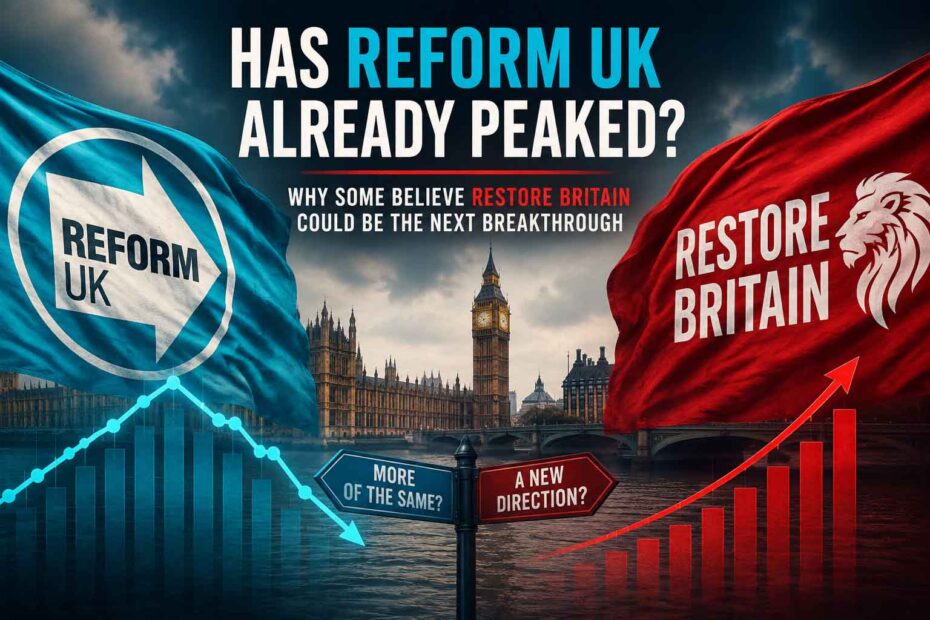
Has Reform UK Peaked?
Why Some Voters Believe Restore Britain Could Be the Next Political Breakthrough
British politics has entered an era of unprecedented volatility. Traditional party loyalties have weakened, public trust in established institutions has declined, and voters are increasingly willing to consider alternatives to the main political parties.
Over the past two years, Reform UK has been the principal beneficiary of this trend. Under the leadership of Nigel Farage, the party has achieved polling figures that would have seemed unimaginable for a relatively new political movement just a few years ago. Reform has consistently challenged, and often surpassed, both Labour and the Conservatives in national opinion polls, establishing itself as a major force in British politics.
However, a growing number of political observers and voters are beginning to ask a different question: has Reform UK already reached its peak?
The Challenge of Sustaining Momentum
Political history demonstrates that building support is often easier than maintaining it.
Reform UK’s rapid rise was driven by a combination of factors. Public frustration with the Conservative government, dissatisfaction with Labour, concerns over immigration, opposition to net zero policies, and a general sense that Westminster was failing to address the issues that matter most to ordinary people all contributed to the party’s growth.
Yet once a political movement reaches a certain level of support, expectations inevitably increase.
Voters who were initially attracted by Reform’s outsider status now expect the party to demonstrate that it can become a credible governing force. Media scrutiny has intensified, internal disagreements have attracted greater attention, and critics have become more effective at challenging the party’s policies and proposals.
For some voters, this represents the point at which enthusiasm begins to plateau.
The Search for a New Alternative
A significant proportion of Reform’s support comes from voters who are not necessarily committed to the party itself, but rather to the broader desire for political change.
These voters often view Reform as a vehicle for challenging the status quo rather than as an end in itself. As a result, they may remain open to supporting another movement if they believe it offers a more effective route to achieving the changes they seek.
This is where supporters of Restore Britain believe an opportunity exists.
Advocates argue that while Reform successfully channelled public frustration, a new movement could potentially capture voters looking for a more structured, disciplined and long-term alternative.
Whether that assessment proves correct remains to be seen, but the argument is gaining traction among those who believe the next phase of political realignment has yet to occur.
The Credibility Factor
One of the biggest challenges facing any emerging political movement is credibility.
Many new parties attract attention but fail to convince voters that they can realistically influence government or win significant representation. The British electoral system has historically made life difficult for smaller parties, meaning that credibility becomes just as important as popularity.
Supporters of Restore Britain argue that their success will depend on demonstrating seriousness, professionalism and a clear vision for the country’s future.
If voters begin to view the movement as a viable political force rather than simply another protest organisation, its growth could accelerate rapidly.
Political history contains numerous examples of parties experiencing sudden surges once a critical mass of voters concludes that supporting them is no longer a wasted vote.
Could Reform Lose Support to Restore Britain?
The central argument advanced by some political commentators is that Reform’s future challenge may not come primarily from Labour or the Conservatives, but from movements competing for the same broad pool of politically dissatisfied voters.
Should Restore Britain establish itself as a credible alternative, it could potentially attract individuals who supported Reform as a protest vote but are now seeking a different political vehicle.
Such a shift would not necessarily indicate that Reform had failed. Rather, it would reflect the continued fragmentation of the political landscape and the ongoing search for alternatives to the traditional parties.
In this scenario, support would not return to Labour or the Conservatives. Instead, it would move between competing anti-establishment movements.
The Importance of Organisation
Political enthusiasm alone rarely delivers lasting success.
For any emerging movement to challenge an established political party, it must build local structures, recruit activists, develop coherent policies and establish a visible presence across the country.
This process takes time and considerable resources.
The organisations that succeed are often those that combine strong messaging with effective grassroots organisation. Voters may be attracted by compelling ideas, but elections are won through sustained campaigning and local engagement.
Whether Restore Britain can build this infrastructure remains one of the key questions that will determine its future prospects.
A Political Landscape Still in Flux
Perhaps the most important point is that British politics remains highly fluid.
The assumptions that dominated politics for decades no longer apply. Voters are increasingly willing to change their allegiance, support new parties and reject established political brands.
As a result, predictions that would once have seemed improbable can no longer be dismissed out of hand.
Reform UK’s rise demonstrated how quickly a political movement can gain momentum when it taps into public concerns. Those who believe Restore Britain could experience a similar breakthrough argue that the conditions which enabled Reform’s success have not disappeared.
If anything, they suggest that public dissatisfaction with the political establishment remains as strong as ever.
Conclusion
The suggestion that Reform UK has peaked remains speculative, and current polling continues to show the party as a major force in British politics. Nevertheless, there is a growing debate about whether the next political surge could come from a different movement.
Supporters of Restore Britain believe that as voters reassess their options, the movement could emerge as a credible alternative and attract support from those who once viewed Reform as the primary vehicle for change.
Whether that prediction proves correct will depend on a range of factors, including leadership, organisation, policy development and public perception.
What is clear is that British politics is undergoing a period of profound transformation, and the competition for voters seeking an alternative to the traditional parties is far from over.