

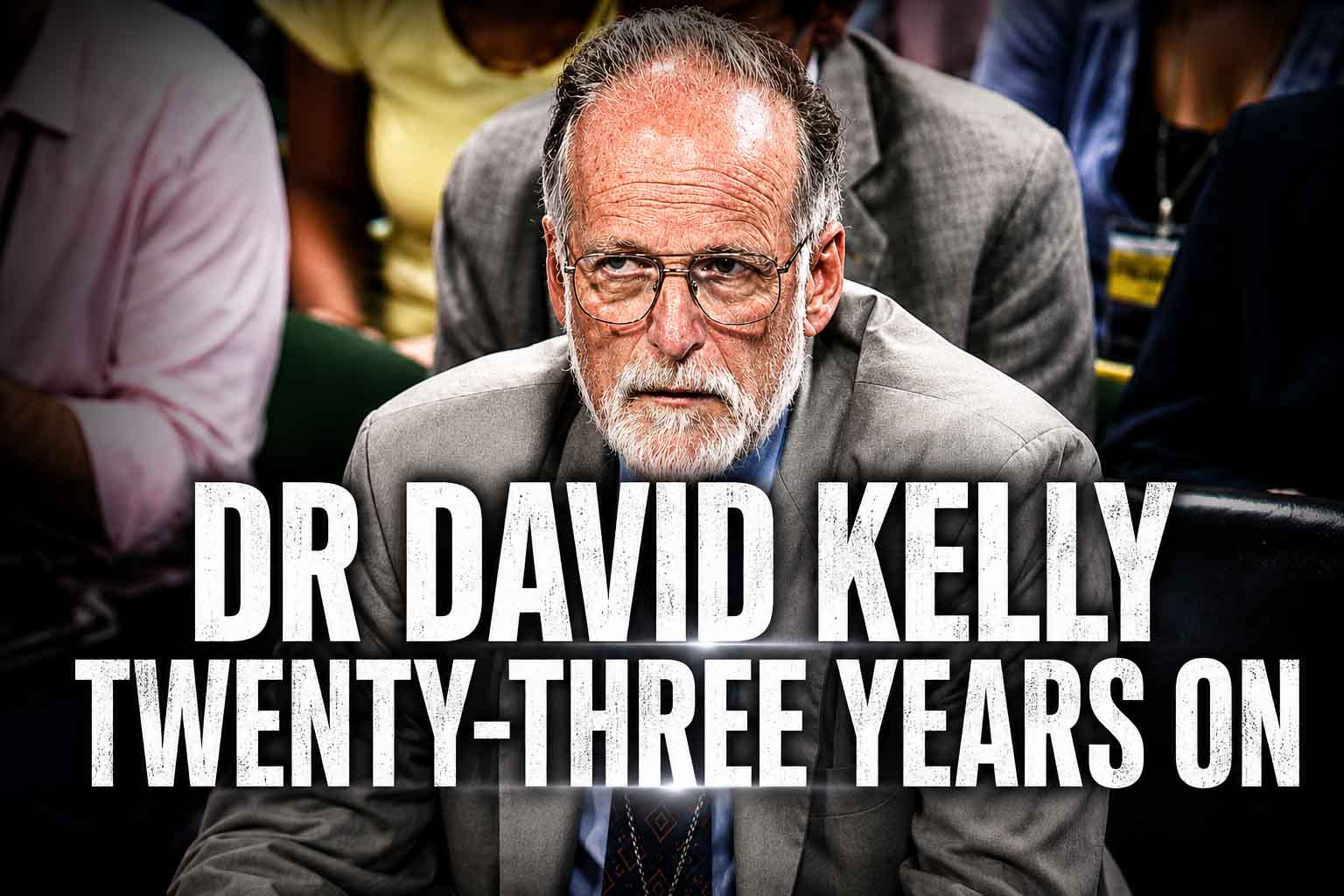
Dr David Kelly Twenty-Three Years On
The Questions That Still Shadow Britain’s Most Controversial Death
Introduction
More than two decades after the death of Dr David Kelly, the circumstances surrounding his final weeks continue to provoke debate, suspicion and political controversy. While the official conclusion remains that he took his own life, critics of that verdict argue that important questions were never fully answered. The result is one of the most enduring and divisive episodes in modern British political history.
Dr Kelly’s death occurred at a pivotal moment in Britain’s involvement in the Iraq War, a conflict whose justification was increasingly coming under scrutiny. His role in exposing concerns about the government’s intelligence claims transformed an internationally respected scientist into a central figure in a political storm from which he never recovered.
The Scientist Behind the Headlines
Dr David Kelly was one of Britain’s foremost experts on biological warfare and weapons inspection. Having worked for the Ministry of Defence and served as a United Nations weapons inspector in Iraq, he possessed unparalleled knowledge of Iraq’s military capabilities and alleged weapons programmes.
By 2003, the government of Prime Minister Tony Blair was facing mounting criticism over the intelligence used to justify military action against Iraq. Central to that debate was the September 2002 dossier, which asserted that Saddam Hussein’s regime could deploy certain weapons within 45 minutes.
In May 2003, BBC journalist Andrew Gilligan reported that a government source had claimed the dossier had been deliberately exaggerated. The report ignited a confrontation between the government and the BBC. Eventually, Dr Kelly emerged as the source who had spoken to journalists, although he disputed some aspects of the BBC’s reporting.
Public Exposure and Political Pressure
Once identified, Dr Kelly found himself at the centre of an extraordinary public controversy. He was questioned by parliamentary committees and subjected to intense media attention.
Witnesses later described a man under considerable strain. His appearance before the Foreign Affairs Select Committee was broadcast nationally, and observers noted the pressure he appeared to be under.
The wider dispute was no longer merely about intelligence assessments. It had become a battle between Downing Street and the BBC over credibility, accountability and the justification for war.
The Events of July 2003
On 17 July 2003, Dr Kelly left his home in Oxfordshire for a walk and did not return. His body was discovered the following morning in woodland near his home.
A knife was found nearby. Medical evidence indicated that he had sustained wounds to his left wrist and had taken painkillers containing co-proxamol. The subsequent post-mortem concluded that haemorrhage from the wrist wounds, combined with the effects of the medication and underlying coronary artery disease, contributed to his death.
The Hutton Inquiry
Rather than allowing the conventional coroner’s inquest process to proceed to completion, the government established the Hutton Inquiry, chaired by Lord Hutton.
The inquiry examined the circumstances surrounding Dr Kelly’s death and the events that led to it. After extensive hearings involving dozens of witnesses and the publication of a vast amount of documentary evidence, Lord Hutton concluded in January 2004 that Dr Kelly had taken his own life. He also criticised aspects of the BBC’s reporting while largely clearing the government of wrongdoing.
The inquiry’s conclusions immediately generated controversy. Critics argued that it failed to scrutinise government actions rigorously enough, while supporters maintained that it had been exceptionally transparent and comprehensive.
Why the Doubts Persist
The enduring controversy surrounding Dr Kelly’s death stems largely from challenges raised by medical professionals and legal commentators in the years that followed.
Several doctors and former coroners questioned whether the severing of the ulnar artery alone would typically result in fatal blood loss. Others queried the quantity of blood reportedly found at the scene and whether the levels of co-proxamol identified were sufficient by themselves to explain the death. These concerns led to repeated calls for a full coroner’s inquest.
Another source of public suspicion was the decision to seal certain medical records relating to the case for an extended period. Critics argued that such secrecy fuelled speculation, while supporters of the decision maintained that it was intended to protect the privacy of Dr Kelly’s family.
In 2010 and 2011, the controversy intensified when senior medical figures renewed calls for an inquest. However, Attorney General Dominic Grieve reviewed the evidence and concluded that there were no grounds for reopening the case. He stated that the evidence supporting suicide was “overwhelmingly strong”.
The Release of Medical Records
In response to growing public concern, previously restricted medical and post-mortem documents were released in 2010. Government ministers argued that publication would strengthen confidence in the conclusions reached by the Hutton Inquiry.
The released documents supported the finding that Dr Kelly’s wounds were consistent with self-inflicted injury and that the medical evidence supported the conclusion of suicide. Nevertheless, critics remained unconvinced, arguing that the newly available material did not resolve all outstanding questions.
Legacy and Historical Significance
The significance of Dr Kelly’s death extends far beyond the question of how he died. His story became inseparable from wider debates about the Iraq War, intelligence failures and public trust in government.
The Iraq conflict itself would later be subjected to extensive scrutiny, culminating in the publication of the Chilcot Report in 2016. While Chilcot did not revisit the circumstances of Dr Kelly’s death, it delivered a highly critical assessment of aspects of the decision-making process that led Britain into war.
For many observers, Dr Kelly became a symbol of the human consequences of political conflict and institutional pressure. To others, the continuing focus on alleged conspiracies obscures the findings of multiple official investigations and reviews.
Conclusion
Twenty-three years after his death, Dr David Kelly remains one of the most consequential and enigmatic figures in modern British public life. The official position is clear: he died by suicide, a conclusion upheld by the Hutton Inquiry, subsequent medical reviews and the Attorney General’s decision not to seek a fresh inquest.
Yet the persistence of public doubt demonstrates that the case occupies a unique place in Britain’s political memory. Whether viewed as a tragedy, a cautionary tale about government accountability, or an unresolved historical controversy, the death of Dr David Kelly continues to raise profound questions about power, transparency and trust in democratic institutions.
What remains beyond dispute is that his name deserves to be remembered—not merely because of how he died, but because of the role he played in one of the defining political crises of the twenty-first century.