

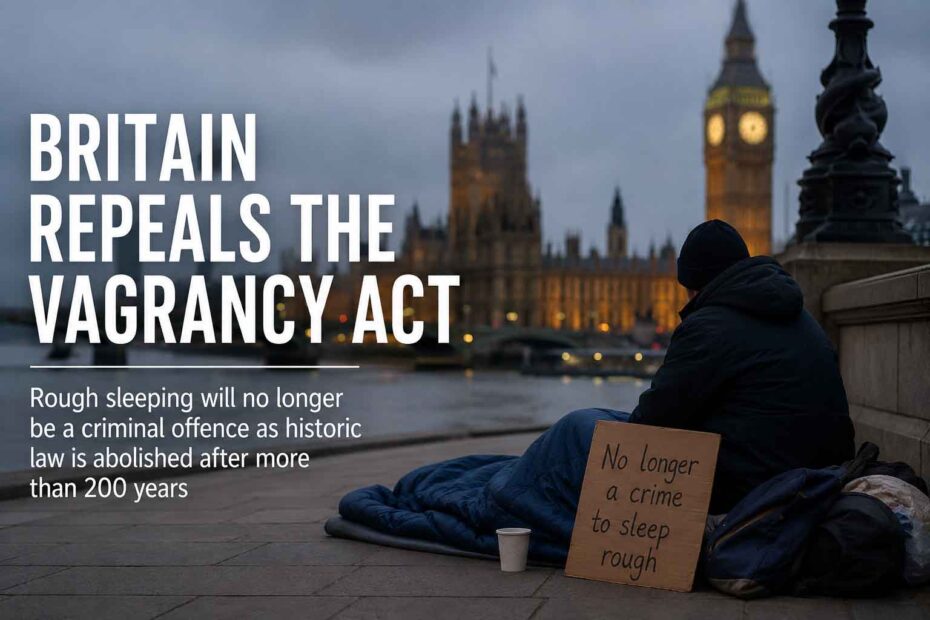
Britain Repeals the Vagrancy Act After More Than Two Centuries
Rough sleeping will no longer be a criminal offence as historic legislation is finally abolished
After more than 200 years on the statute books, the Vagrancy Act 1824 is set to become history. From 29 June 2026, one of Britain’s oldest surviving criminal laws will be formally repealed, ending the criminalisation of rough sleeping in England and Wales.
The move has been described by ministers as a landmark reform that brings the law into line with modern attitudes towards homelessness. While campaigners have welcomed the repeal as a long-overdue recognition that homelessness is a social issue rather than a criminal one, critics argue that the success of the change will ultimately depend on whether adequate support services and housing are available.
A Law Born in a Different Britain
The Vagrancy Act was introduced in 1824 during a period of significant social upheaval. Britain was recovering from the Napoleonic Wars, unemployment was widespread, and thousands of former soldiers and labourers found themselves destitute.
Rather than treating homelessness as a welfare issue, Parliament responded by creating criminal offences aimed at people deemed to be “idle and disorderly” or “rogues and vagabonds”. The legislation gave police powers to arrest those found sleeping rough, begging, or wandering without any apparent means of support.
For generations, the Act was used to remove visible poverty from Britain’s streets, reflecting attitudes of the nineteenth century rather than those of modern society.
Although its use declined significantly in recent decades, the legislation remained legally enforceable well into the twenty-first century.
Why the Law Has Been Repealed
The decision to abolish the Vagrancy Act follows years of campaigning by homelessness charities, legal experts and parliamentarians.
Supporters of repeal argued that criminalising people simply because they were homeless made it harder for them to rebuild their lives. Criminal convictions could create additional barriers when applying for employment, securing accommodation or accessing support services.
The Government has said homelessness should be addressed through housing, healthcare and social support rather than through the criminal justice system. Ministers also argued that vulnerable people were sometimes discouraged from seeking help because they feared prosecution.
Although Parliament approved repeal in 2022, implementation was delayed until replacement legislation was introduced to preserve police powers against genuine criminal behaviour.
What Changes From 29 June?
The repeal removes the offence of rough sleeping itself.
Simply sleeping on the streets or being homeless will no longer constitute a criminal offence under English and Welsh law.
However, contrary to some headlines, the repeal does not legalise every form of begging or street disorder.
Police will continue to possess extensive powers under other legislation to deal with behaviour including:
- Aggressive or intimidating begging.
- Harassment of members of the public.
- Anti-social behaviour.
- Criminal trespass.
- Organised begging operations.
- Exploitation of vulnerable people by criminal gangs.
In effect, the legal focus shifts away from criminalising homelessness itself towards targeting behaviour that causes harm or involves criminal exploitation.
New Powers Replace Old Ones
Alongside repeal, provisions contained within the Crime and Policing Act 2026 introduce offences designed to tackle organised criminal activity associated with begging.
The new measures are intended to address situations where individuals are forced or exploited into begging by organised groups, or where begging is conducted as part of wider criminal enterprises.
The Government argues these powers provide police with the tools they need while ensuring vulnerable rough sleepers are no longer treated as criminals simply because they have nowhere to live.
How Often Was the Act Still Used?
By the early 2020s, prosecutions under the Vagrancy Act had already become relatively uncommon.
Government statistics show that prosecutions had fallen dramatically over the previous two decades, with many police forces preferring to use more modern legislation dealing with anti-social behaviour or public order offences instead.
As a result, the repeal is likely to have greater symbolic significance than operational impact in many parts of the country.
Supporters Welcome a Historic Change
Homelessness organisations have described the repeal as a historic milestone.
Campaigners argue that rough sleeping is often the result of complex issues including housing shortages, family breakdown, addiction, poor mental health or unemployment. They contend that criminal sanctions failed to address these underlying causes and instead pushed vulnerable people further from the support they needed.
Many believe removing the stigma of criminalisation represents an important step towards treating homelessness as a public policy challenge rather than a policing issue.
Critics Remain Cautious
Not everyone is convinced the repeal alone will improve the situation.
Some police representatives and local authorities have questioned whether removing the Vagrancy Act may make it more difficult to address persistent street begging in cases where behaviour does not meet the threshold for more serious criminal offences.
Others argue the repeal risks becoming largely symbolic unless accompanied by sustained investment in affordable housing, addiction treatment and mental health services.
Without those wider reforms, they warn, visible rough sleeping may continue to rise regardless of changes to the law.
A Significant Shift in Public Policy
The abolition of the Vagrancy Act marks the end of legislation that survived more than two centuries of social, political and economic change.
Its repeal reflects a broader shift in public policy, recognising that homelessness is fundamentally a housing and welfare issue rather than a criminal offence.
At the same time, the Government has sought to reassure the public that police retain powers to deal with anti-social behaviour, organised begging and criminal exploitation.
Whether this new legal framework proves successful will depend not only on enforcement, but also on the effectiveness of efforts to reduce homelessness itself. As Britain closes the chapter on one of its oldest criminal statutes, the challenge of ensuring that fewer people are forced to sleep rough remains far from over.