

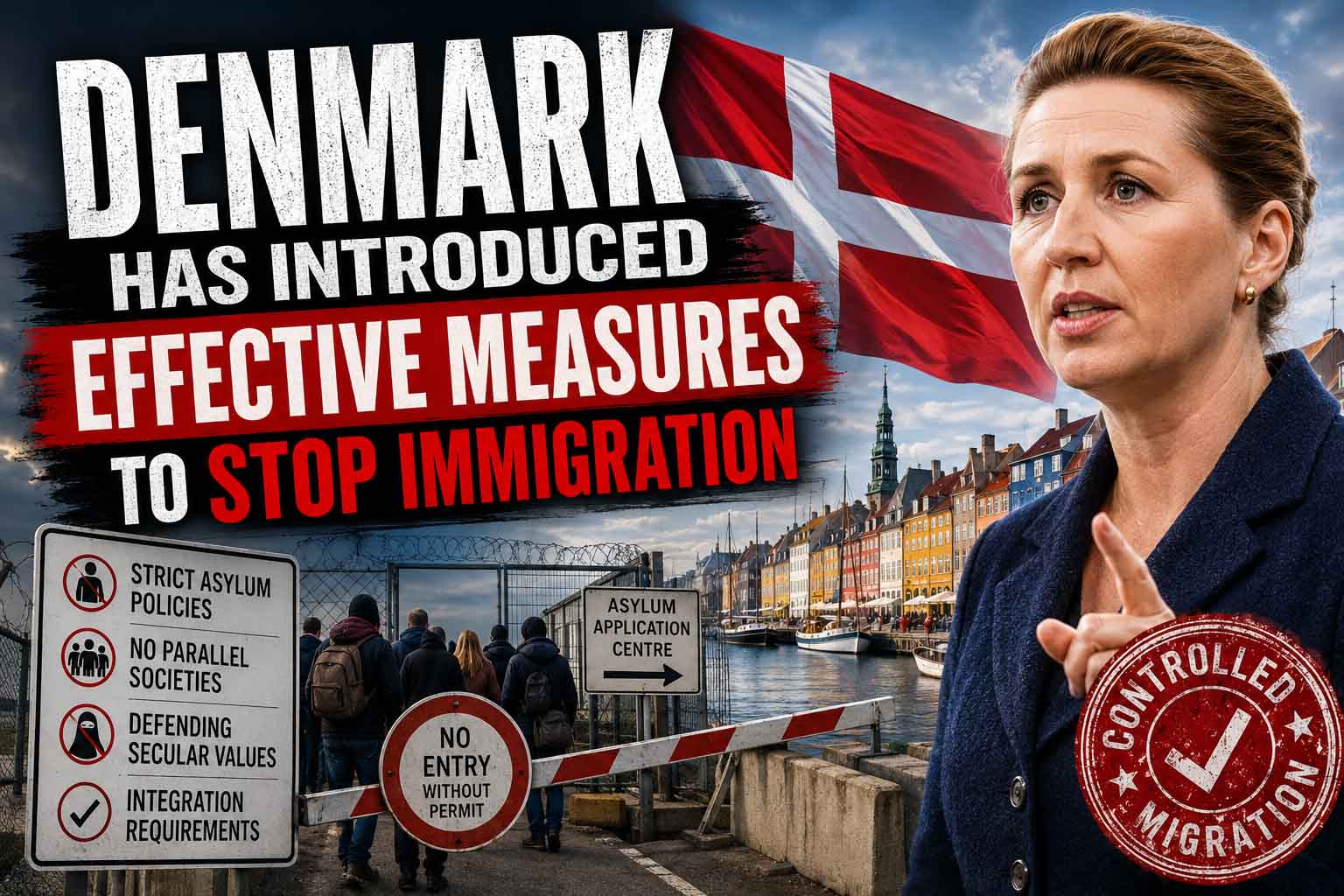
Denmark Has Introduced Effective Measures to Stop Immigration
Over the past decade, Denmark has adopted one of the most restrictive immigration and integration policies in Western Europe. Once regarded as one of the continent’s most liberal and welcoming societies, the country has gradually shifted towards a model that places greater emphasis on cultural cohesion, integration and the long-term sustainability of its welfare state.
Supporters argue that Denmark has acted pragmatically to address the challenges posed by large-scale immigration, while critics contend that many of its policies discriminate against ethnic and religious minorities. Regardless of where one stands in the debate, Denmark’s approach has become one of the most closely watched immigration models in Europe.
From Open Borders to Controlled Migration
For many years, Denmark embraced immigration under the assumption that newcomers would naturally integrate into Danish society. The expectation was that access to education, employment opportunities and the welfare system would encourage immigrants to adopt Danish language, values and customs over time.
However, successive governments became increasingly concerned about growing disparities in employment, educational attainment and welfare dependency among some immigrant communities. Authorities also reported the emergence of neighbourhoods where integration was proving particularly difficult, with higher crime rates, lower employment and reduced use of the Danish language.
These developments prompted a significant shift in public opinion. Rather than opposing immigration in principle, many Danes expressed concern about preserving the country’s high levels of social trust, which underpin its generous welfare system.
Tackling Parallel Societies
One of Denmark’s most controversial initiatives was the introduction of policies aimed at reducing what the government termed “parallel societies”.
Neighbourhoods meeting a combination of social and economic criteria, including unemployment, crime, education levels and the proportion of residents from non-Western backgrounds, were designated for special intervention.
Rather than simply increasing public spending in these areas, the government sought to reshape them physically and socially. Measures included reducing concentrations of social housing through demolition and redevelopment, relocating some residents and encouraging a more mixed population.
Children in designated areas were required to attend nursery education to improve Danish language skills from an early age, while criminal offences committed within these neighbourhoods attracted tougher penalties. Citizenship requirements were also strengthened, with applicants expected to demonstrate knowledge of Danish society and commit to its democratic values.
Supporters argue these measures have reduced segregation and improved integration. Opponents view them as discriminatory and have challenged aspects of the legislation through the courts.
Defending Secular Values
Denmark has also introduced several policies designed to reinforce what successive governments describe as the country’s secular traditions.
In 2018, Parliament approved legislation banning garments that completely cover the face in public places. Although the law applies to all face coverings, it primarily affects the wearing of the burka and niqab.
Government ministers argued that open facial communication is fundamental to Danish society and that face coverings are incompatible with social interaction in public life. Critics, however, described the measure as symbolic and argued that it disproportionately targets Muslim women.
Similarly, Denmark has tightened rules concerning religious accommodation in public institutions. Proposals have included phasing out prayer rooms in schools and universities and increasing oversight of foreign funding for religious organisations.
The government has also taken action against religious leaders accused of promoting anti-democratic or extremist views, insisting that religious practice must operate within the framework of Danish law.
A Tougher Asylum System
Denmark’s asylum system has undergone perhaps its most dramatic transformation.
The country now operates one of Europe’s strictest asylum regimes, with governments openly stating that the objective is to minimise the number of asylum seekers entering Denmark.
Applications have fallen sharply over recent years, with only a small proportion ultimately receiving protection. Residence permits are increasingly viewed as temporary rather than permanent, and unsuccessful applicants are removed from the country wherever possible.
Denmark has also explored processing asylum claims outside Europe and has reduced welfare benefits available to newly arrived migrants in an effort to discourage irregular migration.
Supporters argue that these policies have restored public confidence in the immigration system and reduced pressure on public services. Critics maintain that they undermine international humanitarian obligations.
Political Consensus
Perhaps the most remarkable aspect of Denmark’s immigration policy is that many of the reforms have been implemented by the centre-left Social Democrats rather than traditionally conservative parties.
Prime Minister Mette Frederiksen argued that preserving Denmark’s generous welfare state required tighter control over immigration and stronger expectations of integration.
This repositioning largely neutralised immigration as a dividing issue between the political left and right. Many of the policies originally advocated by more conservative parties gradually became accepted across much of the political spectrum.
The central argument presented by supporters is that a universal welfare system relies upon high levels of trust, shared civic values and successful integration. Without these foundations, they argue, public support for generous social spending may weaken over time.
Influence Across Europe
Denmark’s approach has attracted growing attention from governments across Europe.
Several countries have examined aspects of the Danish model when considering reforms to asylum procedures, integration policies and immigration controls. The emphasis on temporary protection, stronger border controls and expectations of cultural integration has influenced debates well beyond Denmark’s borders.
While each country faces different circumstances, Denmark is increasingly cited as an example of a government willing to implement politically difficult reforms in response to public concerns over migration.
Continuing Debate
Denmark’s immigration policies remain highly controversial.
Supporters point to reduced asylum numbers, efforts to improve integration and attempts to preserve the country’s welfare model as evidence that the strategy has been effective.
Critics argue that some measures unfairly target specific communities, undermine multiculturalism and risk creating discrimination based on ethnic or religious background.
The debate ultimately reflects a broader question confronting many European nations: how can countries balance humanitarian responsibilities with social cohesion, national identity and the long-term sustainability of public services?
Denmark has answered that question with some of the toughest immigration and integration policies in Europe. Whether those policies become a lasting model for other nations remains uncertain, but they have already reshaped the European conversation on immigration and integration.