

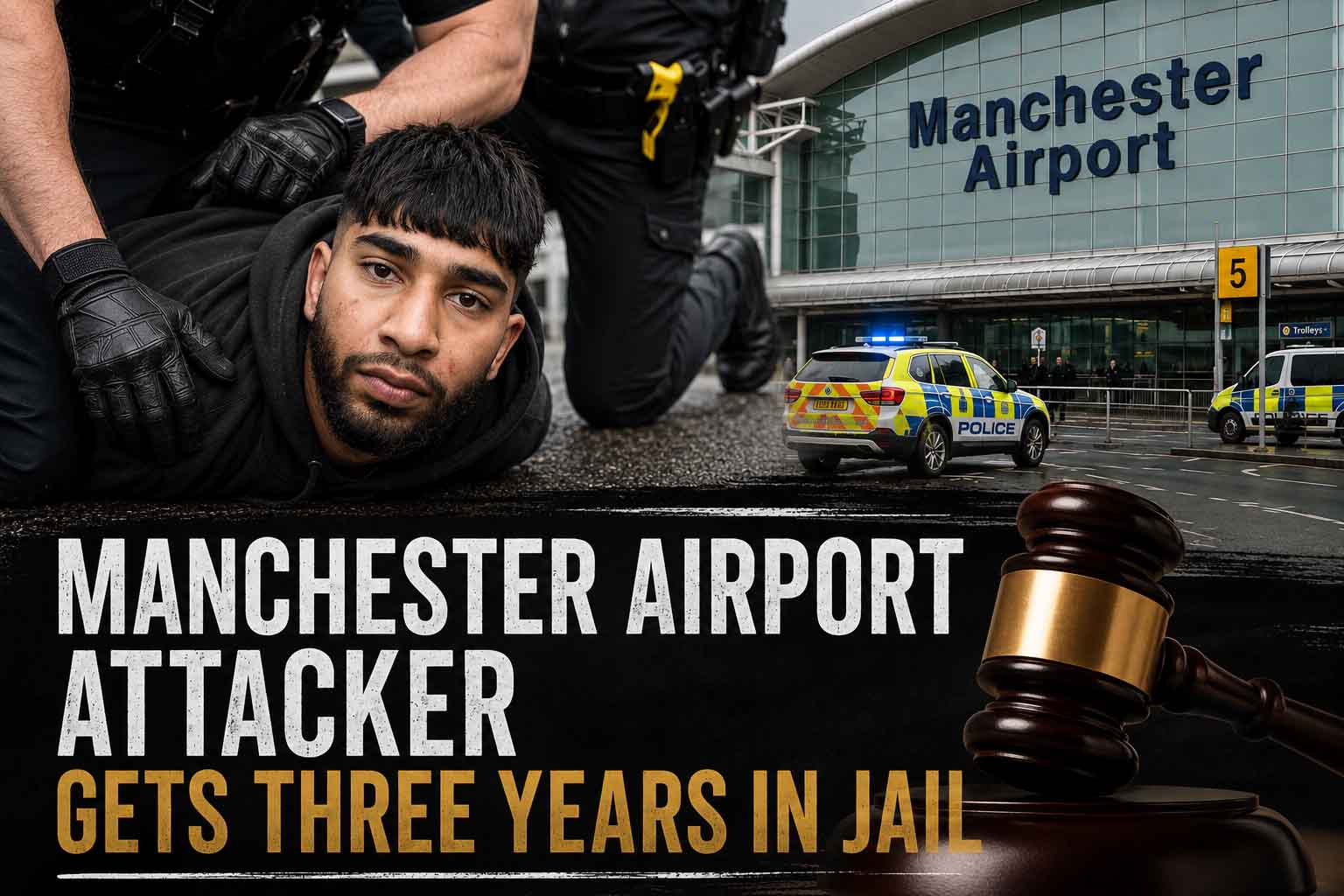
Manchester Airport attacker gets three years in jail
A man convicted of assaulting two female police officers and a member of the public during the violent confrontation at Manchester Airport has been sentenced to three years and six months in prison, bringing one chapter of one of Britain’s most controversial policing incidents to a close.
Mohammed Fahir Amaaz was sentenced on Friday after being found guilty of attacking two Greater Manchester Police officers and a civilian during the disorder at Terminal 2 in July 2024. The incident attracted international attention after footage filmed on a mobile phone appeared to show an armed police officer kicking Amaaz in the head while he lay on the ground. The video rapidly spread across social media, prompting widespread criticism of the police before longer CCTV footage later revealed the events leading up to the confrontation.
The incident
The disturbance began on 23 July 2024 after police responded to reports of an assault inside Manchester Airport. Prosecutors told the court that Amaaz had headbutted and punched a member of the public in a Starbucks before armed officers attempted to arrest him in the airport car park.
What followed was a violent struggle involving several officers.
CCTV footage presented during the trial showed Amaaz throwing ten punches, two elbow strikes and a kick while resisting arrest. Three police officers were assaulted during the incident, while a civilian was also attacked.
The mobile phone footage of an officer kicking Amaaz quickly became one of the most widely shared videos of the year, fuelling accusations of excessive force and sparking protests across the country. However, the subsequent release of more extensive CCTV footage provided additional context, showing the moments before the officer’s actions and leading many to reassess their initial conclusions.
Convictions and retrials
Following his first trial in 2025, Amaaz was convicted of assaulting Police Constable Lydia Ward, Police Constable Ellie Cook and civilian Abdulkareem Ismaeil.
Jurors were unable to reach a verdict on a separate allegation that Amaaz had assaulted Police Constable Zachary Marsden.
The Crown Prosecution Service sought a retrial on that charge, but a second jury also failed to reach a unanimous or majority verdict in May 2026. After two juries were unable to agree, prosecutors decided that pursuing a third trial would not be in the public interest and formally discontinued the charge.
Importantly, the decision to abandon the prosecution was not an acquittal. It simply reflected the fact that two separate juries had been unable to reach a verdict.
The sentence
On 26 June 2026, Amaaz was sentenced to three years and six months’ imprisonment for the assaults on the two female police officers and the civilian.
During sentencing, the court heard that the attacks had caused both physical injuries and lasting psychological effects on the officers involved. The judge described the violence as serious and sustained, reflecting the dangerous circumstances faced by officers attempting to make the arrest.
A separate investigation into police conduct
While Amaaz’s criminal case has concluded, questions surrounding the conduct of one of the arresting officers remain separate.
The Independent Office for Police Conduct opened an investigation into the actions of officers involved, focusing particularly on the kick delivered to Amaaz’s head during the arrest.
In December 2024, the Crown Prosecution Service concluded there was insufficient evidence to bring criminal charges against any police officer. However, misconduct investigations have continued independently of the criminal proceedings.
Debate over sentencing
Amaaz’s sentence has reignited debate over sentencing in England and Wales, particularly on social media.
Many commentators argue that a prison term of three years and six months is too lenient for violent assaults on serving police officers. Comparisons have frequently been made with sentences imposed in other recent cases, including public disorder offences and prosecutions involving offensive material published online.
Critics claim these comparisons suggest inconsistency within the justice system, questioning whether assaults on frontline police officers are punished severely enough.
Others argue that such comparisons can be misleading. Sentencing in England and Wales is governed by statutory guidelines, with judges required to consider the specific facts of each case, the seriousness of the offending, previous convictions, aggravating and mitigating factors, and the maximum penalties available for different offences. As a result, superficially similar cases can produce very different outcomes.
A case that divided opinion
Few criminal cases in recent years have generated as much public controversy as the Manchester Airport incident.
It became a flashpoint in wider debates surrounding policing, the influence of viral social media footage, public trust in law enforcement and the consistency of criminal sentencing.
For some, the case highlighted the dangers faced daily by police officers attempting to arrest violent suspects. For others, it raised serious questions about the use of force by armed officers and the speed with which partial video clips can shape public opinion before all the evidence is available.
With Amaaz now sentenced and one outstanding charge abandoned after two hung juries, the criminal proceedings have largely concluded. Nevertheless, the wider debate surrounding the incident—and what it says about policing, justice and sentencing in modern Britain—is likely to continue for some time.