

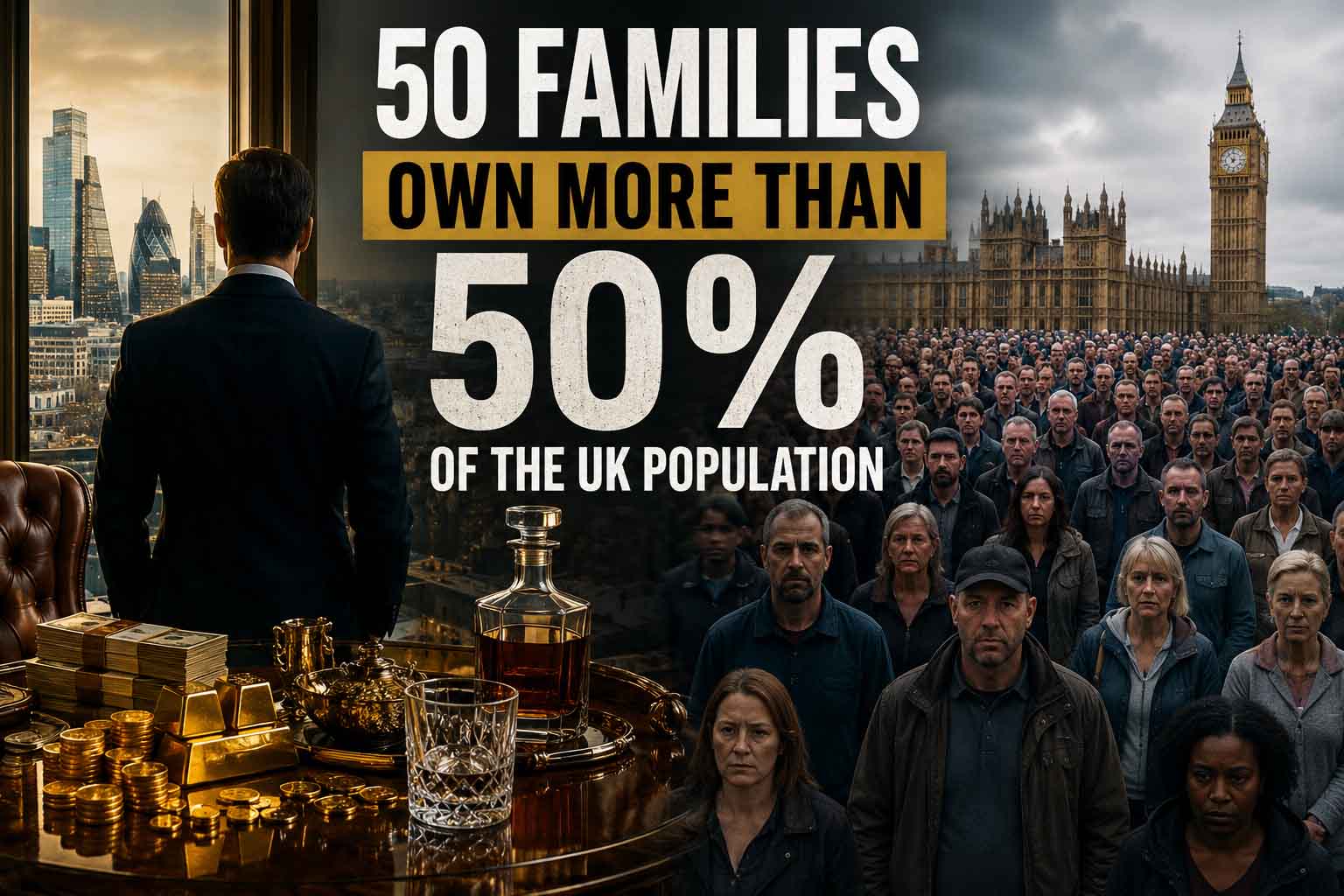
50 Families Own More Wealth Than 50% of the UK Population
Britain has reached a level of wealth inequality that is difficult to comprehend. According to recent analysis, the 50 richest families in the country now possess more wealth than the poorest half of the entire population combined — a staggering comparison that highlights the scale of economic concentration at the very top of society.
The figures suggest that around 50 families control approximately £468 billion in wealth, while the poorest 50% of Britain’s population — roughly 34 million people — own a similar amount collectively.
This is not merely a headline designed to shock. The comparison is based on estimates of the wealth of the country’s richest families, combined with official household wealth data, and it reflects a broader long-term trend of growing inequality.
The wealth of the ultra-rich is largely held in businesses, shares, land, property and investments. It is not necessarily money sitting in a bank account, and the precise valuations can change significantly depending on market conditions. Nevertheless, even allowing for reasonable margins of error, the central reality remains clear: an extraordinarily small number of people control a vast share of Britain’s wealth.
Meanwhile, millions of ordinary people possess relatively little financial security. For many households, their home and pension represent the majority of their assets, while others have little or no wealth after debts are taken into account.
The comparison between 50 families and 34 million citizens has become a powerful symbol of a wider economic divide. Supporters of wealth taxes and greater redistribution argue that such levels of concentration demonstrate that Britain has more than enough resources to tackle poverty, improve public services and reduce social inequality.
Critics respond that wealth is often tied to productive assets that create jobs, investment and economic growth. They argue that aggressive taxation of wealth could discourage enterprise, drive investment overseas and ultimately harm the wider economy.
The debate over how wealth should be distributed is ultimately a political one. There are legitimate disagreements over taxation, government spending and the role of the state in addressing inequality.
What is far harder to dispute is the scale of the imbalance itself.
In one of the wealthiest countries in the world, just 50 families now own as much wealth as the poorest half of the population — around 34 million people.
Whether that is seen as a sign of a broken economic system or the consequence of how modern capitalism operates is the question that Britain must increasingly confront.
There is a distinct difference between successful and wealthy people and the small elite who are not only ultimately in control of everything, they are also the people who support the globalist agenda, which aims to control everyone, hold them to ransom with digital currency and keep them poor, while they have the freedom of the entire globe.
In order to do this, they need to destroy the feeling of nation states in each country, they want people who do not care about the history, heritage or culture of each country, because they have no attachment to it, now how do you think they are achieving that?