

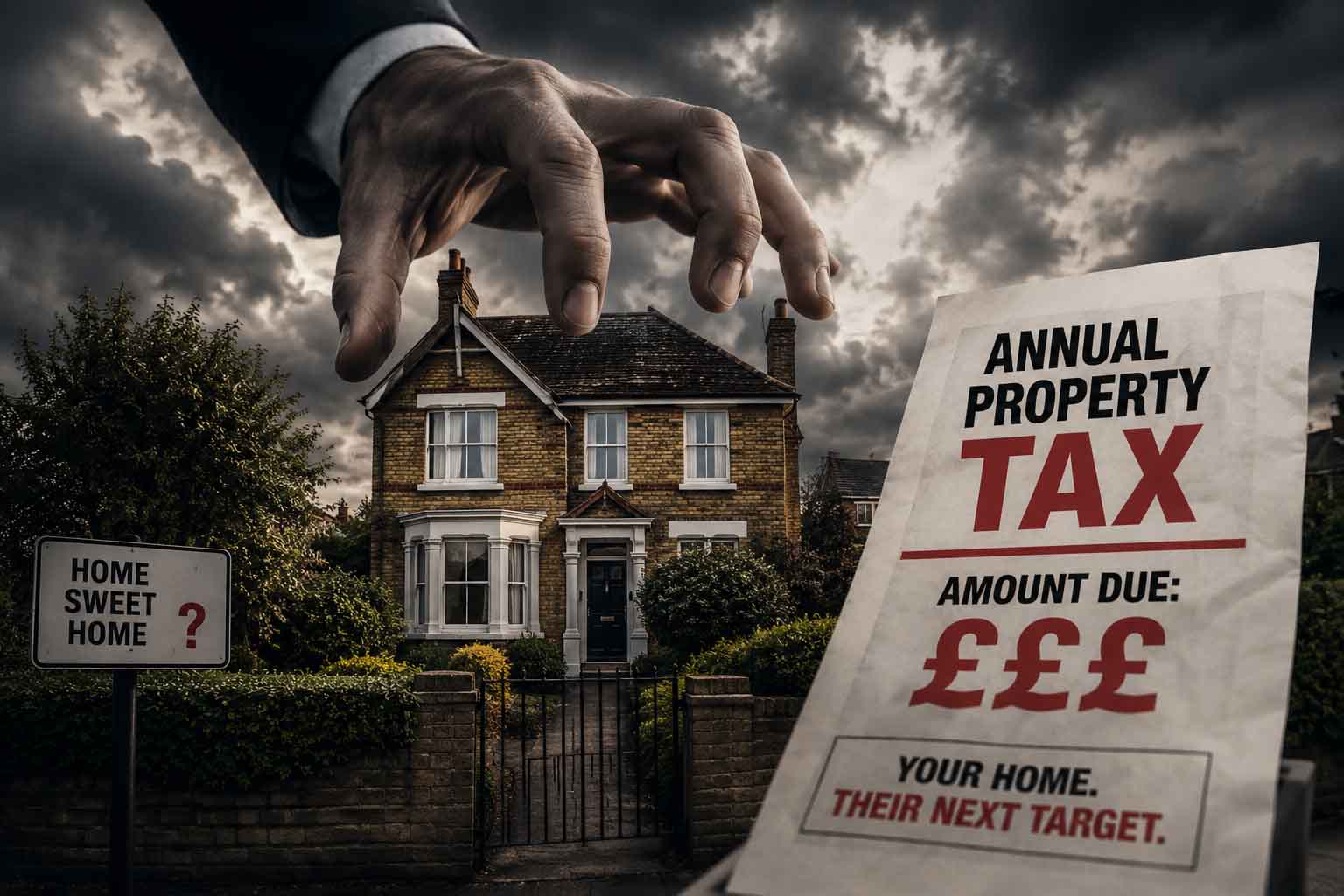
They Are Coming For Your House
It always starts with someone else.
The wealthy. The billionaires. The owners of multi-million-pound mansions. The people politicians insist can afford to pay a little more.
The public is told not to worry.
“This does not affect you.”
But history shows that once a government discovers a new way to tax something, the boundaries have a habit of moving.
Today, the target may be the owner of a £2 million home. Tomorrow, it could be anyone who has spent their lifetime working, saving, and paying off a mortgage, only to discover that ownership no longer means freedom from the tax collector.
The warning signs are already there.
The End of Owning Your Own Home?
The introduction of a high-value council tax surcharge is being sold as a tax on the richest homeowners. An additional annual charge on expensive properties is politically easy to defend because the vast majority of people believe it will never affect them.
That is exactly how new taxes gain acceptance.
Once the principle has been established that the Government can charge an annual fee based simply on the value of your home, the real question is not whether the tax exists — it is where the threshold sits.
And thresholds can change.
A £2 million property may sound like unimaginable wealth today. But what happens after years of inflation, rising property values, and a government desperate for revenue?
What begins as a “mansion tax” can quickly become a tax that reaches far beyond mansions.
The uncomfortable truth is that a home is not merely an investment. For millions of people, it represents decades of sacrifice — the early mornings, the overtime, the missed holidays, the careful budgeting, and years spent building something to leave to their children.
Yet the direction of travel is clear: more taxes on assets, more taxes on savings, and more taxes on what ordinary people have spent their lives trying to build.
The Politics of Wealth — and Who Counts as Wealthy
Politicians increasingly argue that Britain taxes work too heavily and wealth too lightly.
It sounds reasonable.
Until you ask the obvious question:
Who exactly is wealthy?
The billionaire with multiple estates?
The retired couple living in a house they bought 40 years ago that has risen dramatically in value?
The small business owner who has invested everything into their company?
The family who saved carefully and owns a second property as their pension?
The definition of wealth is not fixed. It is written by those who have the power to move the line.
And once that line moves, yesterday’s ordinary citizen becomes tomorrow’s “wealthy taxpayer”.
Tax More, Raise Less?
Supporters of higher taxes often present the argument as simple mathematics: increase the rate and the Government receives more money.
Reality is far more complicated.
Higher capital gains taxes, for example, can discourage people from selling assets, investing, or taking financial risks. When people change their behaviour, the expected tax revenues can fail to appear.
Governments may discover that the money they hoped to collect never arrives — leaving them searching for yet another group to tax.
And the cycle begins again.
The Slow Erosion of Freedom
The concern is not limited to money.
Alongside debates about wealth and property are growing questions about the future of free speech.
The language of modern politics increasingly focuses on preventing harm, reducing hostility, and tackling misinformation. Few people would argue against stopping genuine threats, abuse, or criminal behaviour.
The danger comes when the definition of “harm” becomes so broad that it includes opinions, criticisms, jokes, or political disagreements that some people simply dislike.
A free society is not one where everyone agrees.
It is one where people are allowed to disagree — sometimes passionately — without fearing that the state will intervene.
The right to criticise politicians, government policy, institutions, religions, ideologies, and cultural practices is not a privilege granted by those in power.
It is a safeguard against those in power.
Once people become afraid to speak openly, every other freedom becomes more vulnerable.
Justice Delayed, Justice Denied
The justice system is facing its own crisis.
Court backlogs are enormous. Prisons are overcrowded. Legal aid has been hollowed out over decades, leaving many ordinary people unable to access effective legal representation.
Most people do not think about legal aid until they need it.
Most people do not think about the importance of jury trials until they are standing in a courtroom.
That is the danger of gradual decline.
Rights are rarely removed overnight. They are weakened slowly, piece by piece, until one day people realise that something fundamental has been lost.
Who Watches the Watchers?
The same question must be asked of the media.
A healthy democracy does not depend upon one approved source of information, no matter how respected or historic it may be.
Trust is earned through transparency, accountability, and the ability for competing voices to challenge each other.
When governments begin talking about promoting particular institutions as the primary defence against misinformation, citizens should ask a simple question:
Who decides what counts as the truth?
Throughout history, societies have progressed because ideas have been challenged — not because they have been protected from challenge.
The Real Debate
This is not simply an argument about a tax bill or a property valuation.
It is about the relationship between the individual and the state.
How much of what you earn belongs to you?
How much power should governments have over what you own, what you say, and how you defend yourself in court?
The greatest changes in society rarely arrive with a dramatic announcement.
They arrive slowly.
One new tax.
One new restriction.
One small compromise at a time.
By the time people realise the landscape has changed, they may discover that the things they believed they owned — their property, their rights, and their freedoms — have become conditional on the permission of the state.
The question Britain must now ask is simple:
Are they merely taxing the rich today, or are they laying the foundations to come for everyone’s home tomorrow?