

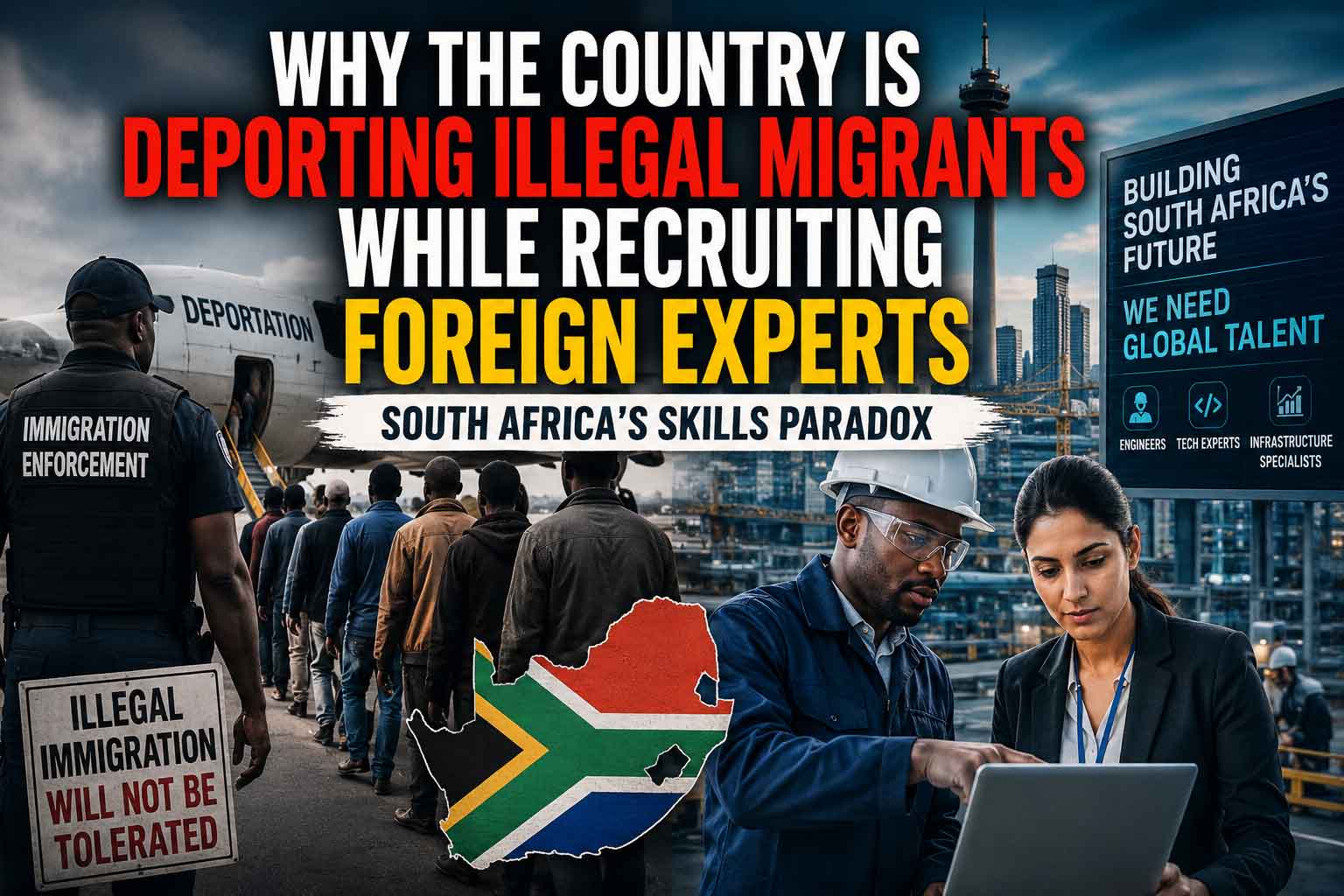
Why the Country Is Deporting Illegal Migrants While Recruiting Foreign Experts
South Africa’s Skills Paradox
South Africa is pursuing two seemingly contradictory immigration policies at the same time. On one hand, the government has intensified its crackdown on illegal immigration, increasing deportations and introducing tougher measures against employers who hire undocumented workers. On the other, it is actively reforming its immigration system to attract highly skilled foreign professionals in an effort to rebuild critical sectors of the economy.
Far from being a contradiction, these policies reflect two very different challenges facing South Africa’s labour market. The country has one of the highest unemployment rates in the world, yet many of its most important industries are suffering from severe shortages of qualified workers. This has created what many economists describe as a “skills paradox”—a situation in which millions of people are unemployed while employers struggle to recruit workers with the expertise needed to keep essential services and industries functioning.
A Labour Market Under Pressure
South Africa’s official unemployment rate remains above 30 per cent, with youth unemployment considerably higher. Yet employers across a range of industries continue to report shortages of experienced engineers, software developers, electricians, millwrights, specialist welders, logistics professionals, healthcare workers and other technically skilled personnel.
The shortage has developed over many years. Weak educational outcomes, declining apprenticeship programmes, insufficient vocational training and the emigration of thousands of experienced professionals have all contributed to a widening gap between the skills available in the domestic workforce and those required by employers.
This mismatch means that while millions of South Africans are looking for work, many vacancies remain difficult to fill because they require specialist qualifications or years of practical experience.
The Crackdown on Illegal Immigration
The South African Government has significantly increased enforcement against illegal immigration, arguing that employers should prioritise legally employed South African citizens wherever possible.
Recent measures include increased workplace inspections, stronger border enforcement, faster deportation processes and proposals to expand the powers of labour inspectors. The government has also announced plans to establish specialised immigration courts to deal more efficiently with immigration-related offences.
These measures are intended to reduce illegal employment, strengthen border security and improve compliance with labour laws.
Businesses employing undocumented workers also face increasing scrutiny, while proposed legislation would give the government greater powers to regulate the employment of foreign nationals across different sectors of the economy.
A Different Approach to Skilled Migration
At the same time as tightening controls on illegal migration, South Africa has been modernising its immigration system to make it easier for genuinely skilled professionals to work in the country.
The Department of Home Affairs has introduced a series of reforms designed to reduce bureaucracy and speed up visa processing for occupations facing critical shortages.
Among the most significant developments is the expansion of the Trusted Employer Scheme. Under this programme, approved companies can benefit from accelerated visa processing when recruiting overseas specialists, allowing businesses to secure highly qualified employees in a matter of days rather than waiting months for applications to be processed.
The government has also continued to refine its points-based approach to skilled migration, placing greater emphasis on professional qualifications, experience, salary levels and occupations identified as being in short supply.
Filling the Critical Skills Gap
South Africa’s Critical Skills List identifies occupations considered essential to economic growth and national infrastructure.
These include specialists in:
- Mechanical, electrical, civil, industrial and chemical engineering.
- Software engineering, cybersecurity, artificial intelligence and data science.
- Industrial maintenance, specialist welding, millwrights and rigging.
- Healthcare and medical specialities.
- Mining engineering and geological sciences.
These occupations are regarded as essential to maintaining and rebuilding South Africa’s infrastructure, manufacturing capacity and digital economy.
Infrastructure Needs Skilled Professionals
The country’s demand for technical expertise extends well beyond the private sector.
State-owned enterprises such as Eskom and Transnet have experienced significant operational challenges over recent years. Electricity generation, freight rail services, ports and municipal infrastructure have all faced periods of serious disruption.
Many analysts attribute part of these difficulties to a long-term shortage of experienced engineers, project managers and technical specialists following decades of emigration by highly skilled South Africans seeking better opportunities overseas.
This so-called “brain drain” has left many organisations with insufficient technical leadership to maintain complex infrastructure or deliver major investment projects.
The Manufacturing Challenge
The impact of labour shortages is particularly visible within certain manufacturing sectors.
Some employers have warned that the removal of experienced migrant workers has created operational difficulties where suitably trained local replacements are not immediately available. Industries that rely on specialist practical skills—such as garment manufacturing and industrial machinery operation—have reported challenges recruiting workers with the necessary experience.
While these concerns are genuine, they should not be interpreted as opposition to immigration enforcement itself. Rather, they highlight the need for improved vocational training and apprenticeship programmes to ensure South Africans can fill these specialist roles over time.
Building Local Skills
Alongside skilled immigration reforms, the government has repeatedly emphasised the importance of developing the domestic workforce.
Proposed changes to employment legislation would require greater oversight of foreign worker recruitment and encourage businesses to demonstrate that local candidates have been considered where appropriate. There is also increasing emphasis on knowledge transfer, ensuring that foreign specialists help train South African employees so that scarce expertise is gradually developed within the domestic labour market.
Although some of these proposals remain subject to parliamentary approval, the broader direction of policy is clear: skilled immigration is intended to complement—not replace—the development of South African workers.
Balancing Two Priorities
At first glance, deporting undocumented migrants while recruiting foreign professionals may appear contradictory. In reality, South Africa is attempting to solve two different labour market problems simultaneously.
The first is reducing illegal employment in lower-skilled occupations and ensuring compliance with immigration and labour laws.
The second is addressing acute shortages of highly specialised expertise that are preventing industries, infrastructure and public services from operating efficiently.
Whether this strategy succeeds will depend not only on attracting overseas talent, but also on improving education, expanding vocational training and creating opportunities for South Africans to acquire the skills that remain in critically short supply.
Conclusion
South Africa’s immigration policy is becoming increasingly selective. The government is tightening enforcement against illegal migration while making it easier for highly qualified professionals to work in occupations where domestic shortages are holding back economic growth.
The approach reflects the country’s complex labour market realities: exceptionally high unemployment exists alongside an equally serious shortage of technical skills. Attracting foreign expertise may help address immediate economic pressures, but long-term success will ultimately depend on rebuilding South Africa’s own pipeline of engineers, technicians, healthcare professionals and skilled tradespeople.
Only by combining effective immigration policy with sustained investment in education and workforce development is South Africa likely to resolve the skills paradox that continues to constrain its economic potential.