

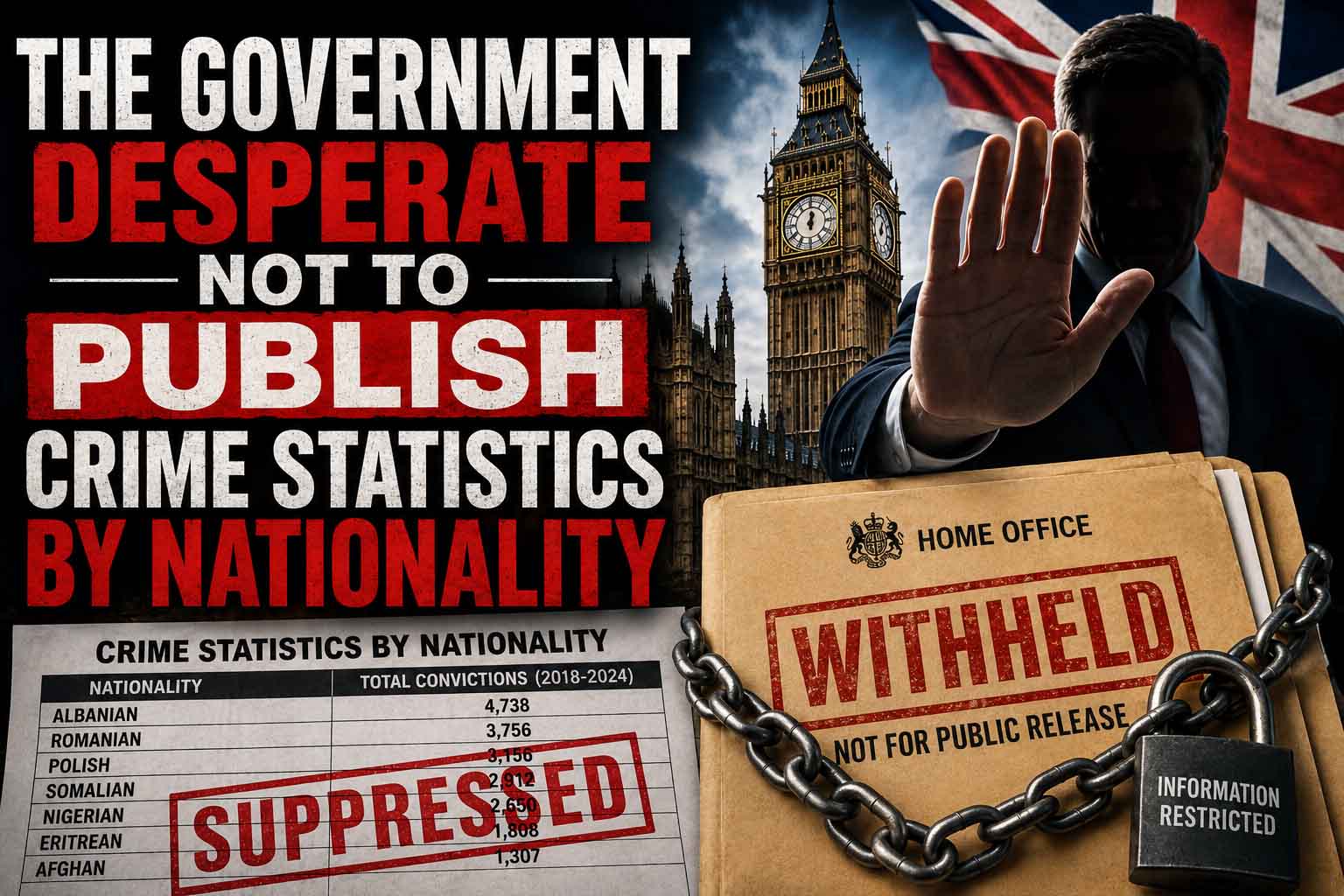
The Government desperate not to Publish Crime Statistics by Nationality
The Transparency Debate at the Heart of Britain’s Immigration Policy
The UK Government has become embroiled in a growing row over whether it should publish official crime statistics broken down by the nationality of offenders. The issue has sparked a wider debate about transparency, public trust and the role of data in shaping immigration policy.
At the centre of the dispute is an appeal by the Home Office against an Information Commissioner’s Office (ICO) decision requiring it to disclose conviction data by nationality following a Freedom of Information request submitted by the Centre for Migration Control (CMC). The requested information covers convictions in England and Wales between 2018 and 2024 across a broad range of offences, including homicide, rape, robbery, serious violence, drugs and weapons offences.
Why the Data Matters
The debate is not simply about crime statistics. It is about whether the Government should routinely publish information that many believe is essential for informed public discussion.
Supporters of publication argue that crime data should be treated no differently from other official statistics already released by government departments. The UK already publishes extensive information on crime by age, sex, ethnicity and geographical location. They argue that nationality should also be included to allow researchers, journalists and the public to better understand trends and evaluate immigration policy.
Campaigners further argue that withholding such information creates suspicion and encourages speculation. In their view, transparency reduces misinformation by allowing independent analysts to scrutinise the evidence rather than relying on anecdotal reports or selective leaks.
The Government’s Position
The Home Office maintains that releasing raw conviction numbers by nationality could lead to misleading conclusions.
Officials argue that nationality alone provides only part of the picture. A person’s nationality does not reveal:
- whether they are a British citizen with dual nationality;
- whether they are a recent arrival or long-term resident;
- their immigration status;
- the size of the resident population for each nationality;
- demographic factors such as age and sex.
Without this context, ministers argue that simple conviction totals could be interpreted incorrectly and potentially distort public understanding. The Government has therefore challenged the ICO’s decision through the appeals process while maintaining that its priority remains removing foreign national offenders and strengthening border security.
The Statistical Challenge
Even many statisticians who support greater transparency caution that crime data should be interpreted carefully.
Raw conviction figures alone cannot be used to calculate offending rates. To make meaningful comparisons, analysts require accurate population data for each nationality over the same period.
This has become particularly difficult following the exceptionally high levels of migration into the UK since 2021. Using population estimates from the 2021 Census alongside conviction data from later years could overstate offending rates for nationalities whose populations have increased significantly since the census was conducted.
Researchers also note that criminal offending varies considerably according to age and sex. Since migrant populations are often younger than the UK average, direct comparisons with the general British population require careful adjustment to avoid producing misleading results.
Transparency Versus Public Confidence
Critics of the Government argue that refusing to release the data risks damaging public confidence more than publication would.
They contend that when official information is withheld, alternative estimates produced by campaign groups, journalists or political parties inevitably fill the vacuum. These competing figures often become the focus of political debate precisely because comprehensive official statistics are unavailable.
Advocates of publication therefore argue that official data, accompanied by detailed methodological notes and appropriate context, would provide a firmer basis for public discussion than continued secrecy.
Conversely, others fear that highly publicised nationality statistics could stigmatise entire communities if presented without sufficient explanation, particularly where differences are driven by demographic factors rather than nationality itself.
An International Perspective
Several European countries already publish crime statistics by nationality or citizenship, although the methodologies differ considerably.
Some countries distinguish between citizens and foreign nationals, while others separate recent migrants from long-term residents. Many statistical agencies also publish age-standardised crime rates to account for differences in population structure.
These examples demonstrate that such data can be published responsibly, provided sufficient contextual information accompanies the figures.
A Question of Trust
Ultimately, the controversy extends beyond immigration.
It raises a broader question about the relationship between government and the public. Democracies depend upon reliable official information to inform public debate, particularly on issues as politically sensitive as immigration and crime.
Whether the eventual figures reveal significant differences between nationalities or not, many observers argue that transparency itself has value. Publishing comprehensive data, together with clear explanations of its limitations, would allow independent experts to scrutinise the evidence and challenge inaccurate interpretations wherever they arise.
The Home Office’s appeal against the ICO ruling will determine whether these statistics become publicly available. Whatever the outcome, the case has already highlighted the growing demand for greater openness in government data and the increasing importance of evidence-based debate on one of Britain’s most contentious political issues.