

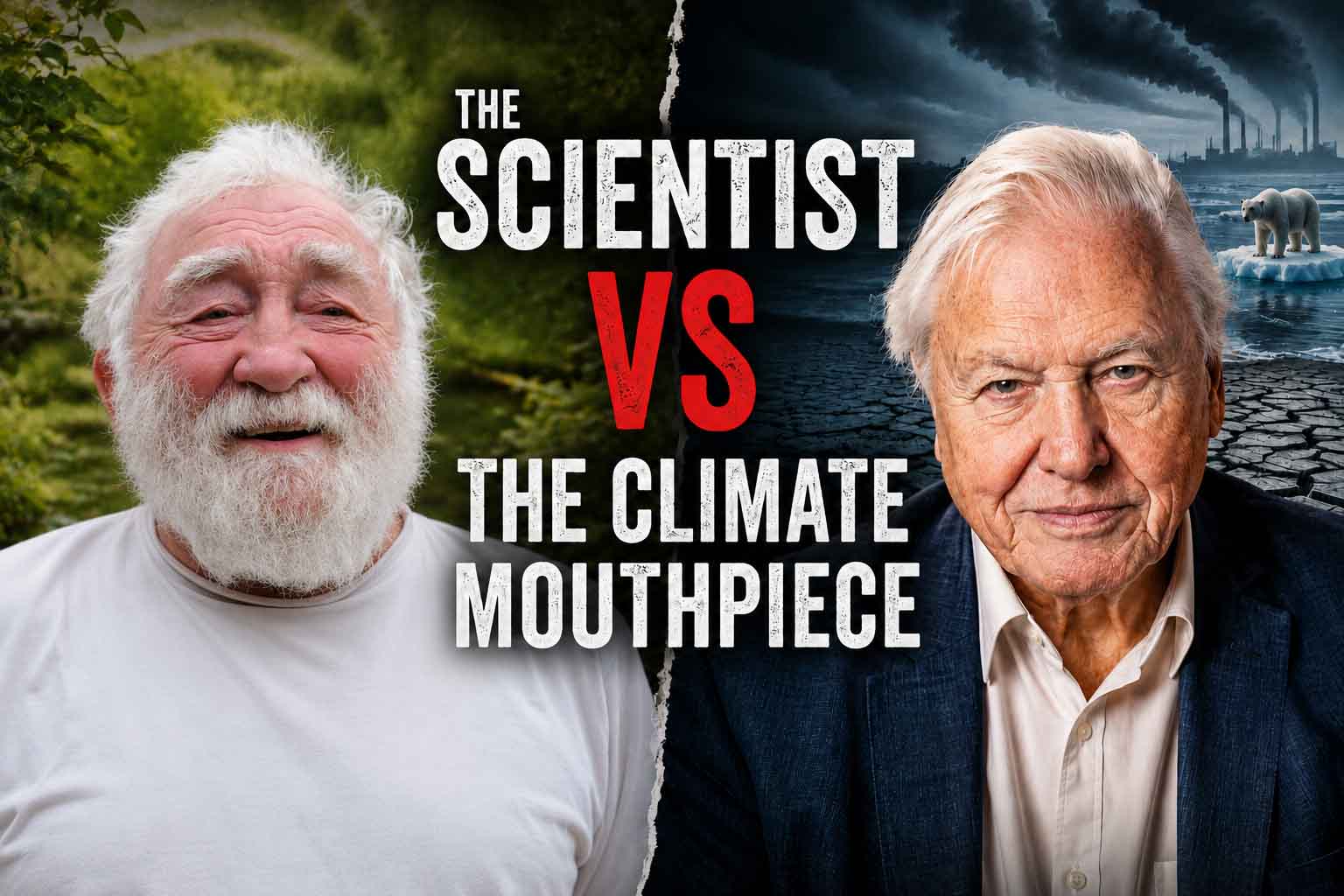
David Bellamy VS David Attenborough
The Climate Change Debate: A Study in Science, Media and Public Trust
Few British naturalists have enjoyed the public affection once commanded by Dr David Bellamy. With his distinctive beard, boundless enthusiasm and ability to communicate complex ecological concepts to ordinary audiences, Bellamy became one of the United Kingdom’s most recognisable environmental figures during the latter half of the twentieth century.
In later years, however, Bellamy became a controversial figure because of his scepticism regarding aspects of mainstream climate science. His criticism of prevailing climate change narratives led some supporters to argue that he was marginalised by broadcasters and environmental organisations, while critics maintained that his views conflicted with the growing scientific consensus on human-induced global warming.
The contrast between Bellamy and Sir David Attenborough has often been presented as a wider story about science, media influence and environmental advocacy.
David Bellamy’s Scientific Background
Unlike many television presenters associated with natural history, David Bellamy was formally trained as a scientist. He earned a degree in botany and later completed doctoral research, establishing himself as a professional botanist before becoming a household name on British television.
Bellamy’s early environmental credentials were substantial. During the 1970s and 1980s he campaigned vigorously against pollution, habitat destruction and unsustainable development. At a time when environmental issues received relatively little political attention, he was among Britain’s most visible conservation advocates.
Because of this background, many of his supporters regarded his later climate-related criticisms as worthy of serious consideration, even when they disagreed with them.
Bellamy and Climate Change Scepticism
During the 2000s, Bellamy became increasingly sceptical of claims that human activity was the dominant driver of recent climate change. He argued that climate variations had occurred throughout Earth’s history and questioned whether the role of carbon dioxide was being overstated in public discussion.
These views placed him at odds with the majority of climate researchers and with assessments produced by international scientific bodies. Bellamy maintained his position despite mounting criticism.
Some commentators have suggested that his scepticism contributed to a decline in his media profile. Bellamy himself occasionally expressed the view that his climate opinions had damaged his broadcasting career. However, establishing a direct causal relationship is difficult, as television careers are influenced by many factors including audience trends, commissioning decisions and changing programme formats.
The Polar Bear Debate
One of the most enduring symbols of climate change campaigning has been the image of a polar bear stranded on a small piece of ice.
Supporters of Bellamy frequently cite his comments regarding such imagery. They argue that photographs showing polar bears on isolated ice floes can be misleading when presented without context, noting that polar bears naturally use sea ice in a variety of ways during hunting and travel.
Wildlife experts generally agree that individual photographs cannot, by themselves, demonstrate long-term population trends or climate impacts. Scientific assessments instead rely on extensive studies of sea-ice coverage, habitat conditions, reproduction rates and population data collected over many years.
As a result, debates over individual images often become symbolic arguments about how environmental issues are communicated to the public rather than decisive evidence for or against climate change.
David Attenborough’s Role
Sir David Attenborough occupies a different position within public life. He is best described as a broadcaster, natural historian and science communicator rather than a climate scientist. His academic background includes the study of natural sciences at Cambridge, but he has never claimed to be a specialist climate researcher.
Attenborough’s influence stems not from conducting climate research himself but from communicating scientific findings to a global audience through documentaries and public broadcasting. Over the past two decades he has increasingly spoken about biodiversity loss, habitat destruction and climate change, reflecting concerns expressed within mainstream scientific institutions.
Critics argue that Attenborough’s programmes sometimes present environmental issues in an overly one-sided manner. Supporters counter that his work reflects the prevailing conclusions of the scientific literature and major scientific organisations.
Questions of Accuracy and Presentation
The debate surrounding Attenborough is not without precedent. In 2013, the BBC removed a climate-related statement from an episode of Africa after questions were raised about the specific temperature figure cited in the narration. Importantly, the correction concerned a particular claim rather than the broader scientific understanding that climate change is occurring. The BBC stated that the evidence for the precise figure used in the programme was disputable and edited the episode accordingly.
This episode illustrates an important distinction: errors or disputed details can occur within environmental reporting without necessarily undermining the larger body of scientific evidence.
Was David Bellamy “Cancelled”?
Whether Bellamy was “cancelled” remains a matter of interpretation.
Those who believe he was unfairly treated point to his reduced visibility in mainstream broadcasting after he became outspoken about climate issues. They argue that dissenting voices were increasingly excluded from public discussion.
Others contend that Bellamy’s decline in media prominence reflected broader changes in television and public communication rather than an organised effort to silence him. They also note that disagreement with a scientific consensus does not automatically entitle a commentator to continued media exposure.
The available evidence does not conclusively prove either interpretation.
Conclusion
David Bellamy and David Attenborough represent two very different approaches to environmental communication.
Bellamy was a trained botanist who became one of Britain’s best-known environmental campaigners before challenging aspects of mainstream climate science. Attenborough is a natural historian and broadcaster whose influence derives from his ability to communicate scientific ideas to mass audiences.
Their contrasting legacies continue to fuel debate about expertise, public trust, scientific consensus and media influence. Regardless of one’s position on climate policy, the discussion highlights a broader question that remains relevant today: how should societies balance expert consensus, legitimate scepticism and open public debate when addressing complex scientific issues?
The answer remains as important now as it was during the careers of both men.