

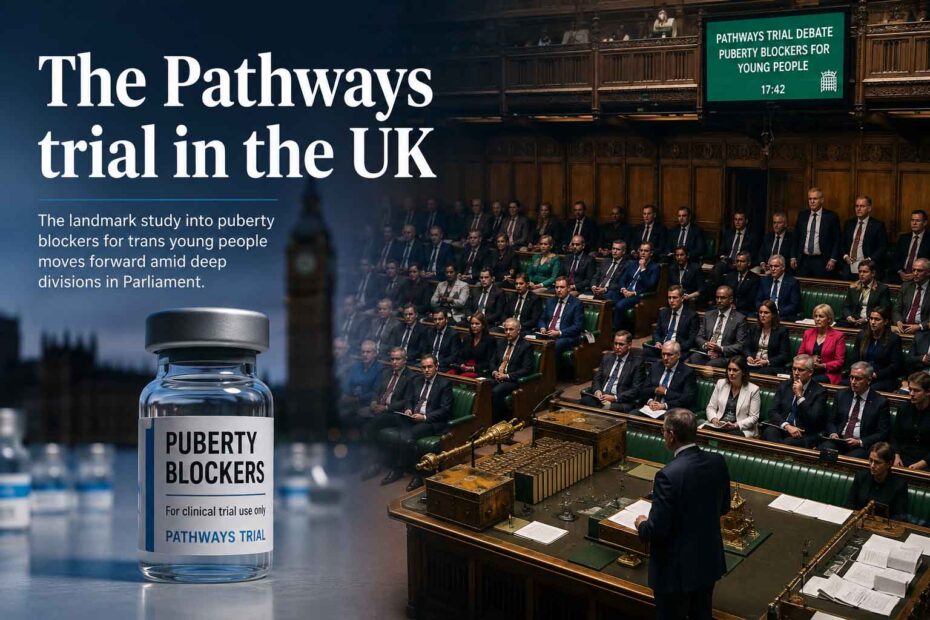
The Pathways Trial in the UK
The debate over healthcare for transgender young people has become one of the most contentious issues in modern British politics. At the centre of that debate is the Pathways Trial, a major NHS-backed research study designed to examine the effects of puberty-suppressing hormones on children and adolescents diagnosed with gender incongruence.
Following a heated debate in the House of Commons and a decisive vote to allow the study to proceed, the trial has become a focal point for wider arguments about evidence, safeguarding, ethics and the future of gender-related healthcare in the United Kingdom.
What Is the Pathways Trial?
The Pathways Trial is a clinical research study led by King’s College London and supported by the NHS. It was developed following recommendations made in the Cass Review, the independent review of gender identity services commissioned by the previous Conservative government and led by paediatrician Dr Hilary Cass.
The trial aims to address what both supporters and critics acknowledge is a significant problem: the lack of high-quality evidence regarding the benefits and risks of puberty blockers for young people experiencing gender-related distress.
Under current NHS policy in England, puberty blockers are no longer routinely available for children with gender incongruence outside approved research settings. As a result, the Pathways Trial represents the primary legal route through which eligible young people may access the treatment.
Approximately 226 participants are expected to take part in the study. Some will begin treatment immediately, while others will start treatment after a delay. Their outcomes will be compared alongside a larger observational group, allowing researchers to gather data on the physical, psychological and social effects of treatment.
The Cass Review and the Evidence Gap
The Pathways Trial emerged directly from the findings of the Cass Review, which concluded that the evidence supporting puberty blockers for gender-distressed young people was limited and of insufficient quality.
Importantly, the review did not conclude that puberty blockers were ineffective or inherently unsafe. Rather, it found that existing research was too weak to draw reliable conclusions about either benefits or harms.
Dr Cass argued that more rigorous research was needed to provide clear answers and help clinicians make informed decisions. The Pathways Trial was designed to fulfil that recommendation.
This has created an unusual situation in which many politicians who cite the Cass Review as justification for restricting access to puberty blockers are now opposing the very research programme that Cass herself recommended.
Why Is the Trial Controversial?
The controversy surrounding the trial stems from fundamentally different views on how uncertainty should be managed.
Critics argue that the long-term effects of puberty blockers on fertility, bone density, neurological development and sexual maturation remain insufficiently understood. They question whether children can provide meaningful informed consent for treatments that may have lifelong consequences.
Some opponents also argue that historical data from the now-closed Tavistock Gender Identity Development Service should be fully analysed before any new participants are enrolled in further studies.
These concerns were strongly represented during the recent House of Commons debate by Conservative MPs, members of the Democratic Unionist Party and several independent MPs. Critics argued that caution should take precedence until more information is available.
Supporters of the trial, however, argue that the absence of evidence is precisely why carefully controlled research is necessary. They contend that refusing to conduct research does not eliminate uncertainty; it merely prolongs it.
Many also warn that restricting access to regulated treatment pathways may encourage some families to seek treatment abroad or through unregulated sources, potentially increasing risks rather than reducing them.
Parliamentary Debate Reveals Deep Divisions
The Commons debate highlighted how sharply divided Parliament remains on the issue.
Opposition to the trial was led by Dr Caroline Johnson, Conservative MP for Sleaford and North Hykeham and a practising NHS paediatrician. Johnson argued that many children experiencing gender incongruence may ultimately become comfortable with their biological sex and questioned whether current eligibility criteria can accurately identify those who may benefit from medical intervention.
Independent MP Rosie Duffield was among those who expressed concerns about informed consent and questioned whether children as young as 11 could fully understand the long-term implications of treatment.
In response, ministers defended the trial as a carefully designed research programme operating under strict safeguards. Government representatives emphasised that participation requires extensive clinical assessment, parental involvement and ongoing monitoring.
Several Labour and Liberal Democrat MPs made forceful arguments in favour of allowing the research to proceed.
Labour MP Samantha Niblett argued that blocking a study designed to generate evidence while simultaneously calling for more evidence was logically inconsistent. She stressed that transgender people exist, have always existed, and deserve healthcare decisions based on robust scientific evidence rather than political rhetoric.
Sarah Owen, Chair of the Women and Equalities Committee, highlighted the experiences of transgender people who often feel excluded from discussions about policies that directly affect their lives. She also noted that puberty-suppressing hormones have been used safely for decades in other medical contexts, including precocious puberty and certain hormone-sensitive conditions.
Former biomedical scientist Olivia Blake argued that the study’s design reflects established research ethics and warned that denying treatment options entirely may lead some vulnerable young people to pursue unsafe alternatives.
Perhaps the most personal contribution came from Care Minister Stephen Kinnock, who disclosed during the debate that his son is a transgender man. His intervention served as a reminder that behind the political arguments are real families navigating complex and deeply personal circumstances.
MHRA Intervention and Enhanced Safeguards
The trial’s path to implementation has not been straightforward.
Earlier this year, the Medicines and Healthcare products Regulatory Agency (MHRA) paused recruitment after raising concerns about aspects of the study protocol, including participant eligibility, safety monitoring and long-term risk management.
Following a review, the trial was approved to proceed under strengthened conditions.
The revised safeguards include more frequent participant monitoring, clearer criteria for withdrawing participants if adverse effects emerge, enhanced oversight by specialist clinical teams and improved information for participants and families regarding fertility preservation and other potential long-term considerations.
Supporters argue that these additional safeguards demonstrate the robustness of the regulatory process. Critics maintain that the intervention highlights continuing uncertainty about the treatment itself.
The Central Question
The debate surrounding the Pathways Trial is often portrayed as a simple dispute over puberty blockers. In reality, the central issue is far broader.
The question facing policymakers, clinicians and families is how best to respond when evidence is incomplete but decisions still need to be made.
One side argues that uncertainty demands extreme caution and that potential risks justify restricting treatment until more information becomes available. The other argues that uncertainty itself is a reason to conduct rigorous research and that delaying evidence generation may leave young people without effective support.
Both positions claim to prioritise the welfare of children. The disagreement lies in how that goal should be achieved.
Looking Ahead
Following Parliament’s decision to reject efforts to halt the study, the Pathways Trial is expected to move forward under its revised protocol.
The results are unlikely to settle every aspect of the wider debate surrounding transgender healthcare. However, they may provide the most comprehensive evidence yet gathered in the United Kingdom regarding the effects of puberty blockers on young people experiencing gender incongruence.
For supporters, the trial represents an opportunity to replace speculation with evidence. For critics, it remains a study that carries risks which they believe have not been fully resolved.
What is certain is that the findings will help shape the future of gender-related healthcare policy for years to come and will play a significant role in determining how the NHS approaches one of the most complex and politically charged medical questions of our time.
The List of Shame
Here is a list of all the MPs who voted to give puberty blockers to vulnerable children as young as 11 years old.
The names listed are:
- Jack Abbott
- Debbie Abrahams
- Luke Akehurst
- Sadik Al-Hassan
- Heidi Alexander
- Douglas Alexander
- Rushanara Ali
- Callum Anderson
- Fleur Anderson
- Scott Arthur
- James Asser
- Jas Athwal
- Catherine Atkinson
- Lewis Atkinson
- Olivia Bailey
- David Baines
- Alex Ballinger
- Antonia Bance
- Paula Barker
- Lee Barron
- Alex Barros-Curtis
- Johanna Baxter
- Danny Beales
- Torsten Bell
- Hilary Benn
- Clive Betts
- Polly Billington
- Olivia Blake
- Rachel Blake
- Chris Bloore
- Elsie Blundell
- Sureena Brackenridge
- Phil Brickell
- Chris Bryant
- Julia Buckley
- Richard Burgon
- Maureen Burke
- David Burton-Sampson
- Liam Byrne
- Ruth Cadbury
- Nesil Caliskan
- Markus Campbell-Savours
- Juliet Campbell
- Alan Campbell
- Dan Carden
- Sam Carling
- Al Carns
- Bambos Charalambous
- Luke Charters
- Ben Coleman
- Jacob Collier
- Lizzi Collinge
- Tom Collins
- Liam Conlon
- Sarah Coombes
- Andrew Cooper
- Beccy Cooper
- Deirdre Costigan
- Pam Cox
- Jen Craft
- Stella Creasy
- Torcuil Crichton
- Chris Curtis
- Nicholas Dakin
- Ashley Dalton
- Paul Davies
- Shaun Davies
- Josh Dean
- Kate Dearden
- Tanmanjeet Singh Dhesi
- Jim Dickson
- Anna Dixon
- Samantha Dixon
- Anneliese Dodds
- Peter Dowd
- Graeme Downie
- Neil Duncan-Jordan
- Angela Eagle
- Maria Eagle
- Cat Eccles
- Sarah Edwards
- Clive Efford
- Damien Egan
- Maya Ellis
- Chris Elmore
- Chris Evans
- Miatta Fahnbulleh
- Hamish Falconer
- Josh Fenton-Glynn
- Patricia Ferguson
- Emma Foody
- Catherine Fookes
- Paul Foster
- Vicky Foxcroft
- Mary Kelly Foy
- Daniel Francis
- Gill Furniss
- Allison Gardner
- Anna Gelderd
- Becky Gittins
- Ben Goldsborough
- John Grady
- Nia Griffith
- Amanda Hack
- Louise Haigh
- Sarah Hall
- Paulette Hamilton
- Carolyn Harris
- Lloyd Hatton
- Tom Hayes
- John Healey
- Mark Hendrick
- Chris Hinchliff
- Sharon Hodgson
- Rachel Hopkins
- Claire Hughes
- Alison Hume
- Patrick Hurley
- Natasha Irons
- Sally Jameson
- Dan Jarvis
- Terry Jermy
- Kim Johnson
- Gerald Jones
- Lillian Jones
- Ruth Jones
- Gurinder Singh Josan
- Sojan Joseph
- Warinder Juss
- Chris Kane
- Mike Kane
- Afzal Khan
- Stephen Kinnock
- Jayne Kirkham
- Gen Kitchen
- Sonia Kumar
- Uma Kumaran
- Peter Kyle
- Laura Kyrke-Smith
- Peter Lamb
- Ian Lavery
- Noah Law
- Kim Leadbeater
- Brian Leishman
- Emma Lewell
- Andrew Lewin
- Clive Lewis
- Simon Lightwood
- Rebecca Long Bailey
- Alice Macdonald
- Andy MacNae
- Seema Malhotra
- Amanda Martin
- Rachael Maskell
- Keir Mather
- Alex Mayer
- Douglas McAllister
- Kerry McCarthy
- Martin McCluskey
- Andy McDonald
- John McDonnell
- Lola McEvoy
- Pat McFadden
- Alex McIntyre
- Gordon McKee
- Kevin McKenna
- Jim McMahon
- Frank McNally
- Kirsty McNeill
- Anneliese Midgley
- Julie Minns
- Navendu Mishra
- Grahame Morris
- Joe Morris
- Chris Murray
- James Murray
- Katrina Murray
- Luke Myer
- Connor Naismith
- Kanishka Narayan
- Josh Newbury
- Samantha Niblett
- Charlotte Nichols
- Alex Norris
- Melanie Onn
- Simon Opher
- Abena Oppong-Asare
- Tristan Osborne
- Sarah Owen
- Andrew Pakes
- Matthew Patrick
- Matthew Pennycook
- Toby Perkins
- Bridget Phillipson
- Lee Pitcher
- Jo Platt
- Luke Pollard
- Joe Powell
- Gregor Poynton
- Richard Quigley
- Connor Rand
- Andrew Ranger
- Angela Rayner
- Ellie Reeves
- Rachel Reeves
- Jonathan Reynolds
- Martin Rhodes
- Bell Ribeiro-Addy
- Jake Richards
- Jenny Riddell-Carpenter
- Marie Rimmer
- Dave Robertson
- Tim Roca
- Matt Rodda
- Sarah Russell
- Oliver Ryan
- Sarah Sackman
- Louise Sandher-Jones
- Jeevun Sandher
- Michelle Scrogham
- Mark Sewards
- Baggy Shanker
- Andy Slaughter
- John Slinger
- Cat Smith
- Jeff Smith
- Nick Smith
- Karin Smyth
- Alex Sobel
- Euan Stainbank
- Jo Stevens
- Kenneth Stevenson
- Elaine Stewart
- Will Stone
- Alistair Strathern
- Alan Strickland
- Lauren Sullivan
- Peter Swallow
- Mark Tami
- Alison Taylor
- Fred Thomas
- Gareth Thomas
- Adam Thompson
- Marie Tidball
- Stephen Timms
- Jessica Toale
- Henry Tufnell
- Matt Turmaine
- Laurence Turner
- Derek Twigg
- Liz Twist
- Harpreet Uppal
- Chris Vince
- Christian Wakeford
- Chris Ward
- Paul Waugh
- Chris Webb
- Michelle Welsh
- Catherine West
- Andrew Western
- Matt Western
- Michael Wheeler
- John Whitby
- Jo White
- Nadia Whittome
- David Williams
- Sean Woodcock
- Rosie Wrighting
- Yuan Yang
- Daniel Zeichner
Total names listed: 236 MPs.