

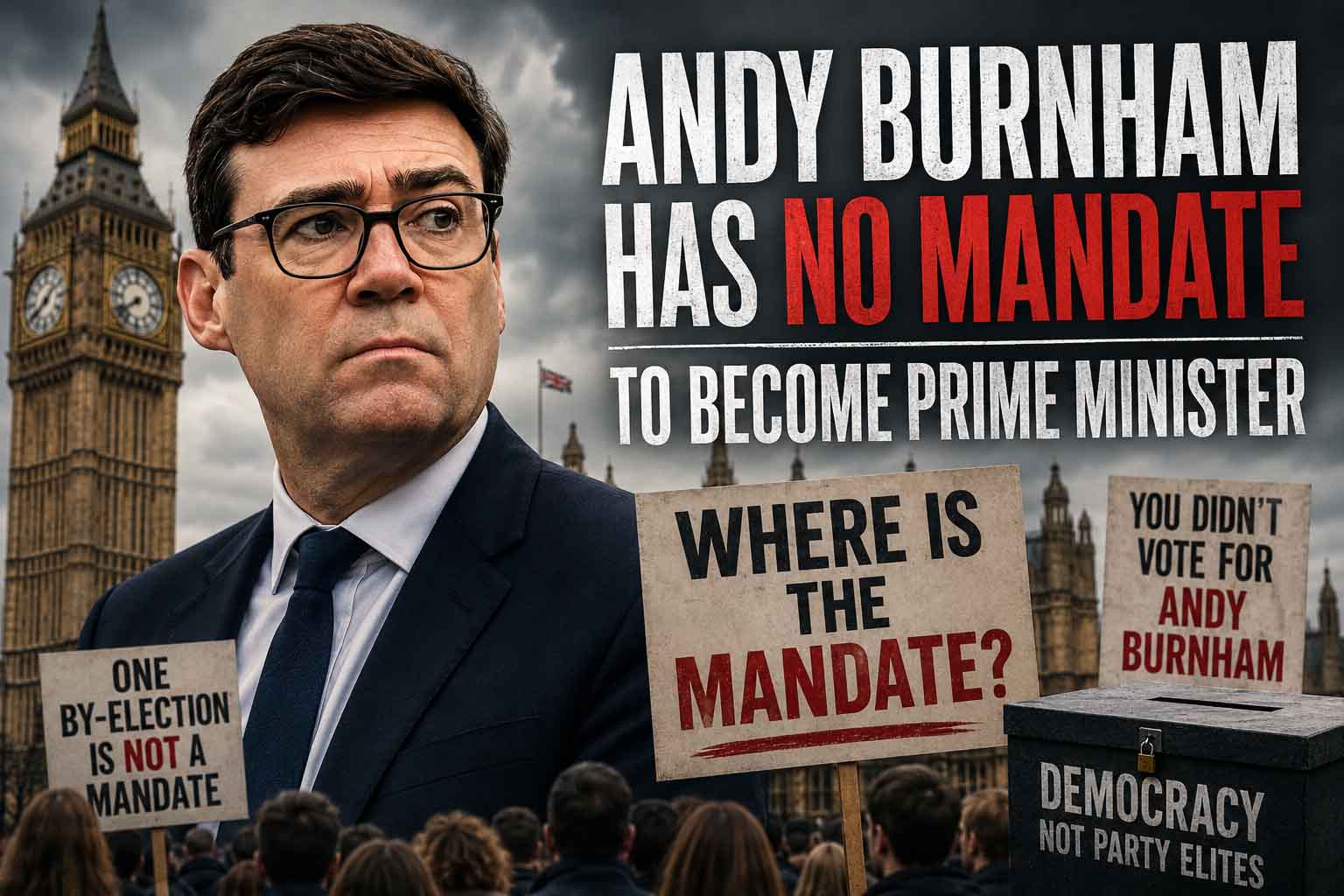
Andy Burnham has no mandate to become Prime Minister
The rapid ascent of Andy Burnham to the leadership of the Labour Party and, potentially, to the office of Prime Minister represents a striking departure from democratic norms. While the UK’s constitutional conventions permit a party to replace its leader internally, the circumstances surrounding Mr Burnham’s prospective premiership raise profound questions about legitimacy, accountability, and the consent of the governed.
In the 2024 general election, Labour secured a substantial parliamentary majority on the basis of a specific manifesto and under the leadership of Sir Keir Starmer. The British people voted for that platform and for the team assembled around Sir Keir. Mr Burnham, who was not even a Member of Parliament at the time of that election, played no direct role in securing that mandate. He re-entered the Commons only recently via a by-election in Makerfield. To install him as Prime Minister without a fresh general election is to ask the country to accept a leader chosen by party insiders rather than by the electorate.
This process bypasses the fundamental principle that governments derive their authority from the people. Critics, including Nigel Farage and others, have rightly highlighted that crowning a new Prime Minister on the back of a single by-election victory lacks democratic weight. The public did not vote for Mr Burnham as leader, nor did they endorse any potential shift in policy direction he might pursue. A Prime Minister who assumes office in this manner cannot credibly claim the same popular consent that Sir Keir Starmer secured at the ballot box.
Furthermore, significant policy differences may emerge. Mr Burnham’s record as Mayor of Greater Manchester and his public positioning suggest a potentially distinct emphasis from Starmerism, particularly on issues affecting the North and devolution. Any departure from the 2024 manifesto — on fiscal rules, welfare, or other priorities — would compound the legitimacy deficit. Major changes implemented without a renewed mandate risk being seen as an abuse of the parliamentary majority won under different leadership.
British political history shows several instances of mid-term transitions, but the speed and manner of this one are exceptional. The public has grown weary of revolving-door leadership and insulated Westminster manoeuvres. Polling and commentary indicate that many voters, while dissatisfied with Sir Keir, do not necessarily support an immediate internal handover without broader consultation.
The remedy is clear: Mr Burnham should seek his own mandate through a general election at the earliest practicable opportunity. This would allow the British people to judge him and his vision directly. Anything less risks entrenching the perception that power in Britain is increasingly determined by party elites rather than the electorate. Democratic legitimacy is not a technicality; it is the foundation of stable and trusted governance. In the absence of a fresh general election, Andy Burnham would govern without the explicit consent of the British people.