

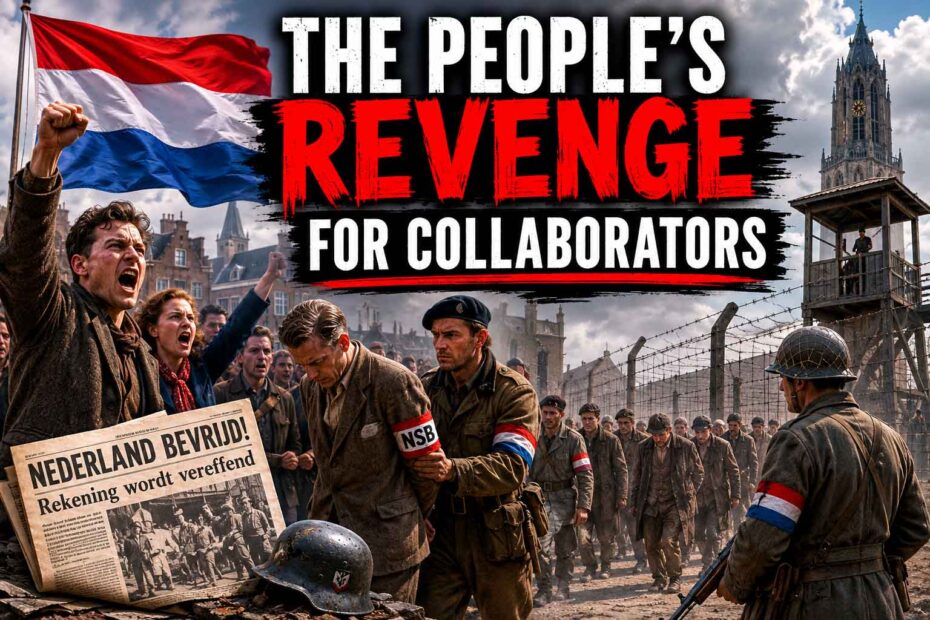
The People’s Revenge for Collaborators
When the Second World War ended in Europe in May 1945, the Netherlands erupted in celebration. After five years of brutal Nazi occupation, liberation brought relief, jubilation and the promise of rebuilding a shattered nation. Yet alongside those celebrations came another, darker chapter in Dutch history—one marked by vengeance, retribution and, in some cases, lawlessness.
While official records show that only 39 to 43 collaborators were executed following formal legal proceedings, this figure tells only part of the story. Thousands of Dutch citizens suspected of collaborating with the German occupation were arrested, imprisoned and, in many cases, subjected to violence outside the courtroom. The contrast between the official statistics and the wider reality has fuelled historical debate for decades.
Preparing for Liberation
Even before Germany’s surrender, the Dutch government-in-exile recognised that liberation could trigger widespread reprisals against collaborators. To prevent mob justice from spiralling out of control, it established the bijzondere rechtspleging—the Special Justice system—which was designed to investigate and prosecute those accused of assisting the occupation.
Despite these preparations, events unfolded rapidly as German authority collapsed. In many parts of the country, formal government institutions had yet to re-establish control, creating a power vacuum in which acts of revenge took place.
The chaotic days surrounding liberation became known colloquially as bijltjesdag, or “Hatchet Day”, reflecting widespread fears that collaborators would face immediate and often violent retaliation.
Mass Arrests
The scale of the post-war purge was immense.
Historians estimate that between 120,000 and 175,000 people were arrested in the months following liberation. Over the following years, around 425,000 individuals came under investigation, while approximately 300,000 passed through some stage of the Special Justice system.
Those detained included members of the National Socialist Movement (NSB), the Dutch Nazi Party, members of the Landwacht, informants, officials who had served the occupation authorities and civilians suspected of assisting German forces.
Many were held in hastily established internment camps across the country.
Harsh Conditions Behind Barbed Wire
The internment camps were never intended to become long-term prisons. Many were improvised facilities staffed by former resistance fighters or volunteers with little formal training. Emotions remained raw after years of occupation, and discipline often proved inconsistent.
Research by leading Dutch historians documents overcrowding, inadequate sanitation, poor nutrition, limited medical care and instances of physical abuse. Prisoners were frequently subjected to humiliation, while some suffered severe beatings or neglect.
Deaths did occur within these camps through illness, poor conditions and mistreatment. However, the precise number remains disputed.
Some publications and online sources claim that between 3,000 and 5,000 detainees died in Dutch internment camps between 1945 and 1948. Yet this figure is not supported by the leading academic works on the subject or by material published by the Dutch National Archives. While historians agree that abuses were widespread and fatalities occurred, the available evidence does not currently substantiate mortality on that scale.
The conditions themselves, however, are not seriously disputed.
Justice in the Streets
Not all retribution occurred within prison walls.
During the final days of occupation and immediately after liberation, suspected collaborators were assaulted, publicly humiliated and, in some cases, summarily executed by resistance groups or enraged civilians.
Members of the NSB, Landwacht personnel and individuals believed to have informed on neighbours were particularly vulnerable.
Unlike formal executions carried out after trial, many of these killings were never officially recorded. Local archives, cemetery records and eyewitness testimony demonstrate that extrajudicial violence occurred across the country, although historians continue to debate its overall scale.
Because many incidents happened during a breakdown in civil authority, establishing an exact death toll has proved impossible.
The Meaning Behind the Official Number
The frequently quoted figure of 39 to 43 executions refers solely to those who were sentenced to death by the Special Courts and executed following legal proceedings.
It excludes deaths resulting from mob violence, fatal assaults during arrest, suicides, deaths in detention and other forms of post-war retribution.
For this reason, citing the official execution figure alone can create a misleading impression that post-war justice in the Netherlands was conducted entirely through the courts.
The historical record paints a more complicated picture.
A European Pattern
The Netherlands was far from unique in experiencing violent reprisals after liberation.
In France, the épuration sauvage—or “wild purge”—is estimated to have claimed around 9,000 to 10,000 lives before the restoration of legal authority. Italy also witnessed thousands of summary executions of Fascists and collaborators during the chaotic final months of the war.
Although the scale of violence in the Netherlands appears to have been smaller, historians generally agree that post-liberation retribution extended well beyond the official judicial executions recorded in government statistics.
Remembering a Difficult History
For many years after the war, Dutch public memory understandably focused on resistance, occupation and national liberation. The treatment of collaborators received comparatively little attention, partly because it remained politically and emotionally sensitive.
Only in later decades did historians begin examining the internment camps, extrajudicial violence and the broader workings of the Special Justice system in greater depth.
Their research has revealed a more nuanced reality than either official execution statistics or exaggerated claims suggest. The Netherlands sought to replace vengeance with the rule of law, yet in the chaotic aftermath of occupation, justice and revenge often existed side by side.
Understanding that distinction is essential. The official total of judicial executions remains historically accurate within its narrow legal definition, but it does not encompass the wider experience of post-war retribution. At the same time, claims of several thousand deaths in internment camps have yet to be substantiated by the strongest available historical evidence.
The truth, as is so often the case in history, lies between the extremes: the liberation of the Netherlands brought both justice through the courts and acts of vengeance outside them, leaving behind a complex legacy that historians continue to study more than eighty years later.
Does history repeat itself?
Collaborators have been punished by the people they have betrayed many times throughout history, despite the fact that the media do try to hide the real figures of those who were just dragged out and shot after the war, the reality was quite different.
At a time when Europe is under attack, society is collapsing and white Europeans are victims of violence and rape on a daily basis, the question is:
“Will history repeat itself?”